






The CCPROTO represents the genesis of a Promethean figure within the world of bicycle design and fabrication. Back in the 1970s, Charlie Cunningham took a break from modifying ultralight-weight weenie road bike projects and created the CCPROTO, the most innovative bicycle of the era. Many of his creations were 40 years ahead of the mainstream bike industry. Framebuilders are often heralded as being the true innovators of the mainstream bike industry, and today we will take a close look at one such innovator whose work continues to be ahead of the curve.
Tasshi Dennis from Vintage Mountain Bike Workshop and John Watson once again teamed up to deliver the crème de la crème of Cunningham documentation. Read on for a mind-melting report on the most innovative framebuilder to ever live…
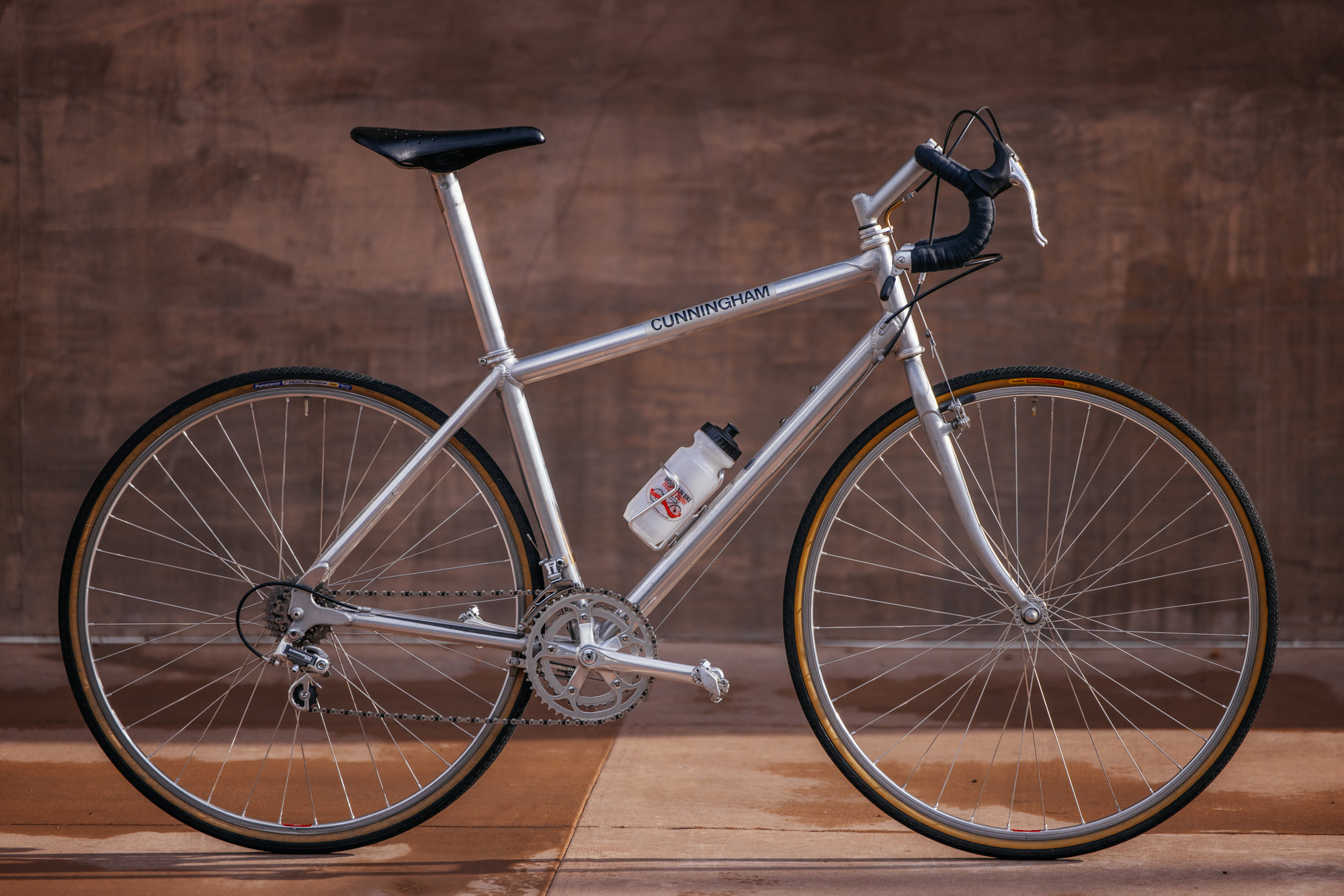
CCPROTO: Much More Than An OG Gravel Bike
What does it take to really think outside the box when designing or creating something?
Is it a skill that can be taught, is it a method that can be practiced, or are people simply born with this ability?
For example, many of us are taught how to play music at a young age, and with 10,000 hours of practice, we can perfect that skill. We can faithfully play what others have composed, adding our own interpretation in the process. With time, we can also reverse roles and learn how to write or improvise our own music, which usually conforms to certain pleasing styles and is guided by the structure of music theory. And yet, some composers can take their musical creations in entirely new directions and start new genres along the way.
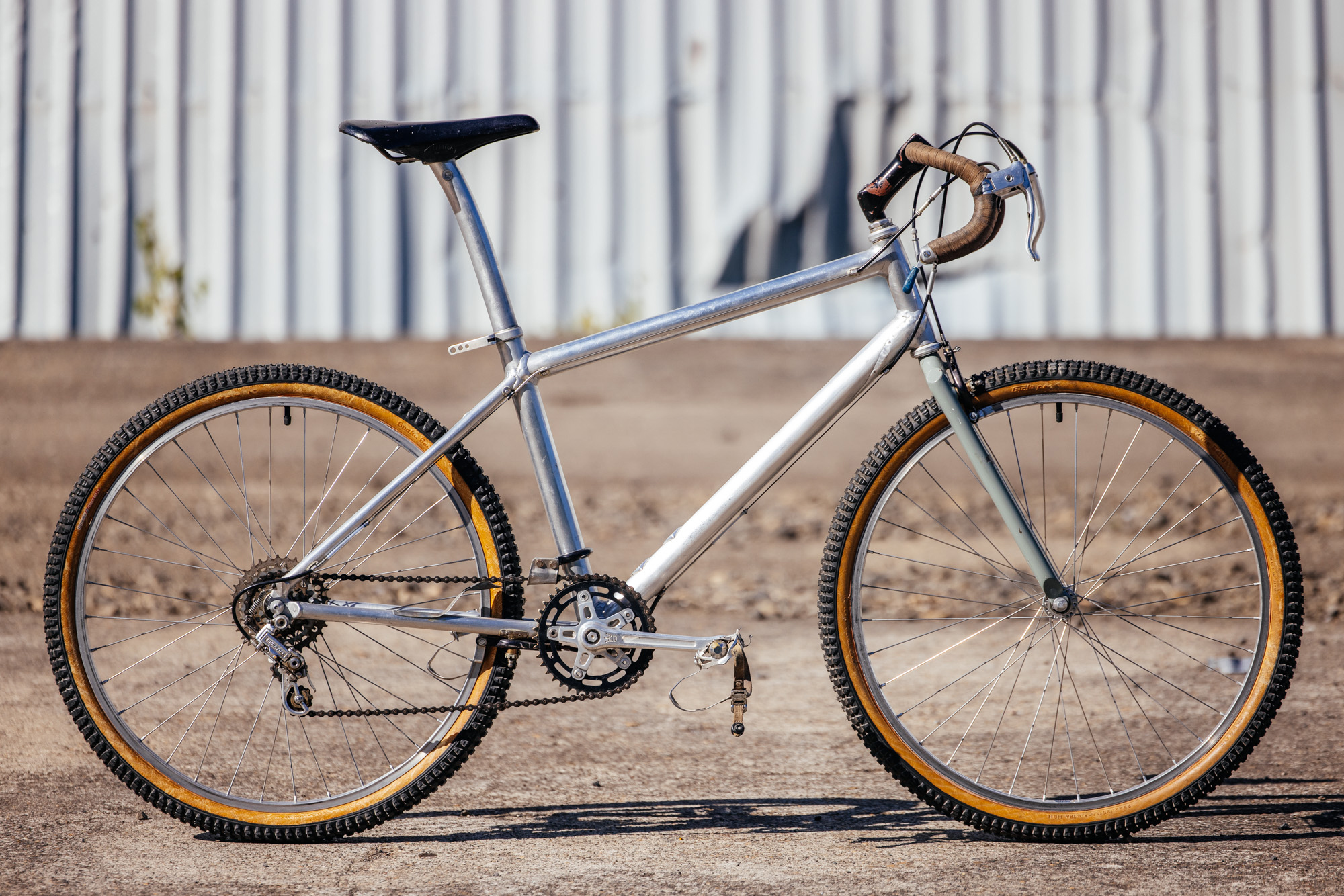
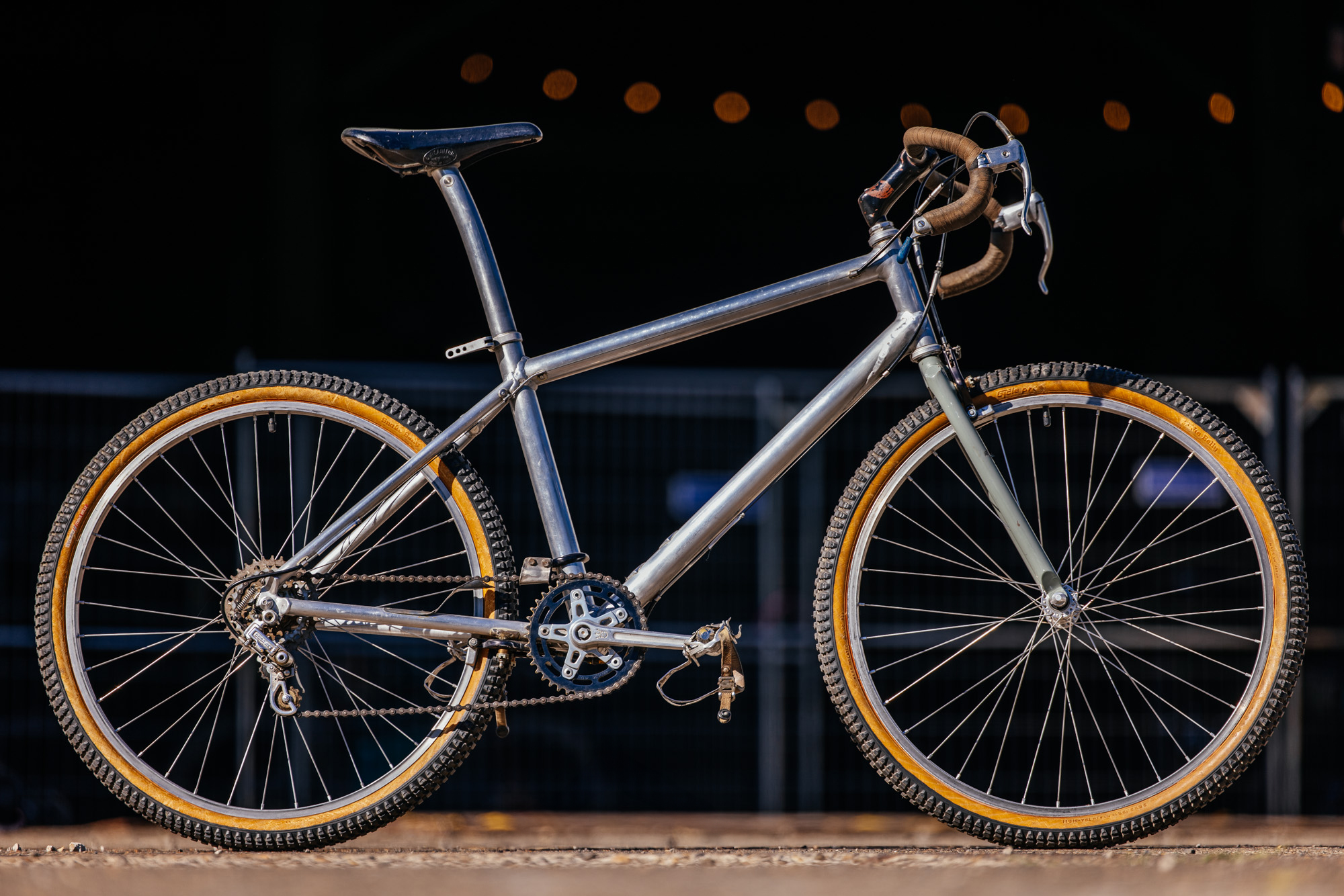
The re-welded/repaired CCPROTO
Some people seem to have a knack for doing this repeatedly. Since it’s not easy, how do they do it? The reality is that we each live in a society, not a vacuum, and we are heavily influenced by those who came before us and those around us now. When creating something, it’s too easy to do variations on a theme; a little of this mixed with a little of that often ends up looking like everything else. But some people bring to the design table broader perspectives, greater diversity of thought, a higher tolerance for risk, a greater sense of independence, a disregard for tradition, and patience and willingness to think very deeply about a problem.
With this in mind, we take a detailed look at the early creative work of Charlie Cunningham and ask what influenced him and what guided his creativity. How did he come up with so many novel ideas decades before the industry recognized their merits and adopted them?
With the recent popularity of gravel bikes with big tires, it’s easy to want to call his first mountain bike an OG gravel bike. But there is much more to the bike, which he would complete the construction of in late 1979 and eventually become known as CCPROTO, the world’s first aluminum mountain bike. Although many photos of this bike have been shared recently on social media, an in-depth description of the bike and how it came about has been lacking… until now.
Guiding Principles
The first thing to know about Charlie Cunningham is that he was a weight weenie before this bike was made. More specifically, the worst kind: a road bike weight weenie.
In the late 70s, Charlie was modifying road bikes and components to reduce as much weight as possible, culminating in his 1974 Alan, which he had ordered from Mel Pinto Imports. At 16.6 pounds, this was a bike from which Charlie would conclude that he had met the limits of minimalism. Utilizing bits of titanium, magnesium, plastic, and exotic aluminum alloys, Charlie would shave every possible gram off the bike, even resorting to only partially wrapping the handlebars. As he began to ride this bike off-road while other people rode solid klunkers, he realized that the 1-inch aluminum tubes were far too small for the task of resisting flex.
After all, under hard braking, the front tire would rub the bottom of the downtube on this bike.
Incidentally, despite being an aluminum bicycle pioneer, Charlie would never develop an aluminum fork, which he concluded was the wrong material for the application. Around this time, a local bike shop in his hometown of Fairfax, CA, had a gleaming new road bike by Gary Klein, which caught Charlie’s eye. To acquire this bike, with its oversized, thin-wall aluminum tubing to counteract flex, Charlie put up his modified Alan for sale. But instead of purchasing the Klein, he would instead end up buying a Lincoln IdealArc TIG (you can guess where this was going). The emphasis on lightweight bicycle construction with aluminum had been set, and now Charlie had the tools to start making his own. It just happened that the first 26-inch aluminum rims, from Araya and Ukai, and lightweight tires, from Cycle Pro Snake Belly, first became available in 1979, which got Charlie very excited about the prospects of a lightweight off-road bike.
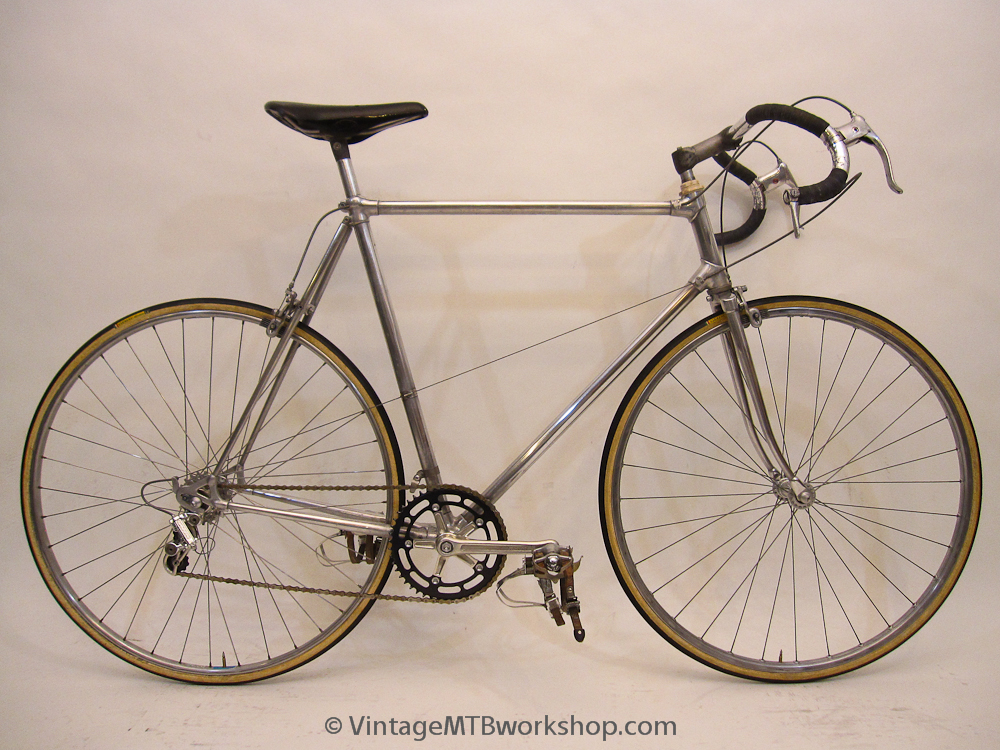
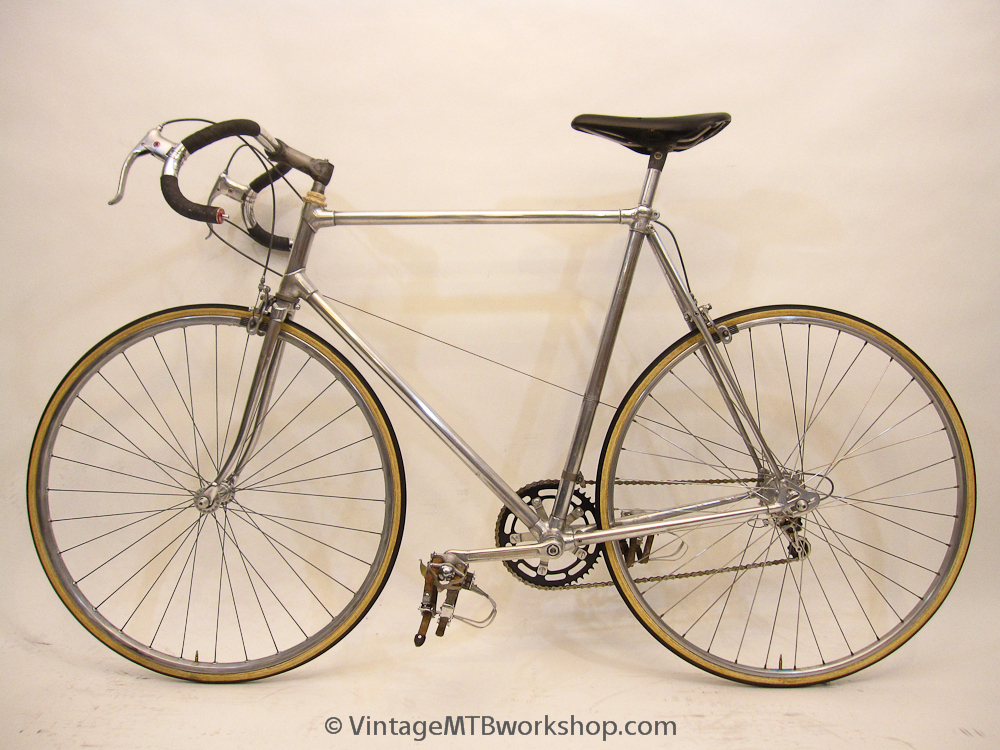
The second thing to know about Charlie is that he had been trained as an engineer at Berkeley with an interest in aerospace, although he never completed his degree. Whereas many of the mountain bike pioneers were primarily skilled craftsmen or garage tinkerers, Charlie approached the design of bicycles as an engineering problem. He viewed them as highly efficient, refined structures that allowed one to cover long distances across potentially rough terrain. Similarly, aside from passenger comfort, airplanes only have what is needed to make them safe and reliable to fly. You don’t bump out the fuselage just to add more curb appeal like the fenders of a sports car.
Minimal weight and high strength matter most, which is just about the opposite of the klunker bicycles of the era with their thick-walled tubing and soft alloy steels. In the aerospace industry, magnesium is used to minimize weight in parts that can be bulky, steel is used for ultimate strength without too much flex, and titanium is used for strength and low weight in small parts such as fasteners. Similarly, rivets and epoxies join diverse materials so that the best characteristics can be employed. Before the sophisticated carbon fiber construction methods of today, aluminum was the choice for large structures such as air frames. There weren’t aluminum alloys such as 7005 designed explicitly for bicycle construction, so working with the ubiquitous 6061 alloy required post-weld heat treatment. This process is something Charlie would figure out how to do effectively in his shop, which was particularly challenging when trying to avoid warping the thin tubing.
The third thing to know about Charlie is that he is a very independent thinker, by which he constantly questions conventional wisdom and has little desire to maintain standard appearances. Why was something designed a certain way decades ago? Can it be made better, either through a small modification or an entirely different approach? He questioned nearly everything. This doesn’t just apply to bicycle design, but to all aspects of life, from the way we dress, what we eat, where we sleep, how we travel, how we socialize, and what we find entertaining. It takes a fiercely independent person to resist social pressure and norms, but in exchange, it is a tremendous freedom to experience the world differently from everyone else. So many possibilities become available.
The general design of the bicycle has been slowly honed over many decades as people adopted incremental changes. Road cycling in the 1970s was full of dogma, and there have always been strict rules surrounding competition; rebel mountain bikers were going to destroy much of that. Yet people in the earliest klunker days already had some notion of what an off-road bicycle should look like, from handlebars that came off motorcycles to frames with horizontal top tubes like road bikes to wheel dimensions adopted from cruisers. Why? Perhaps because it is easier to make use of what is readily available to quickly build consensus and public recognition for a fledgling sport.
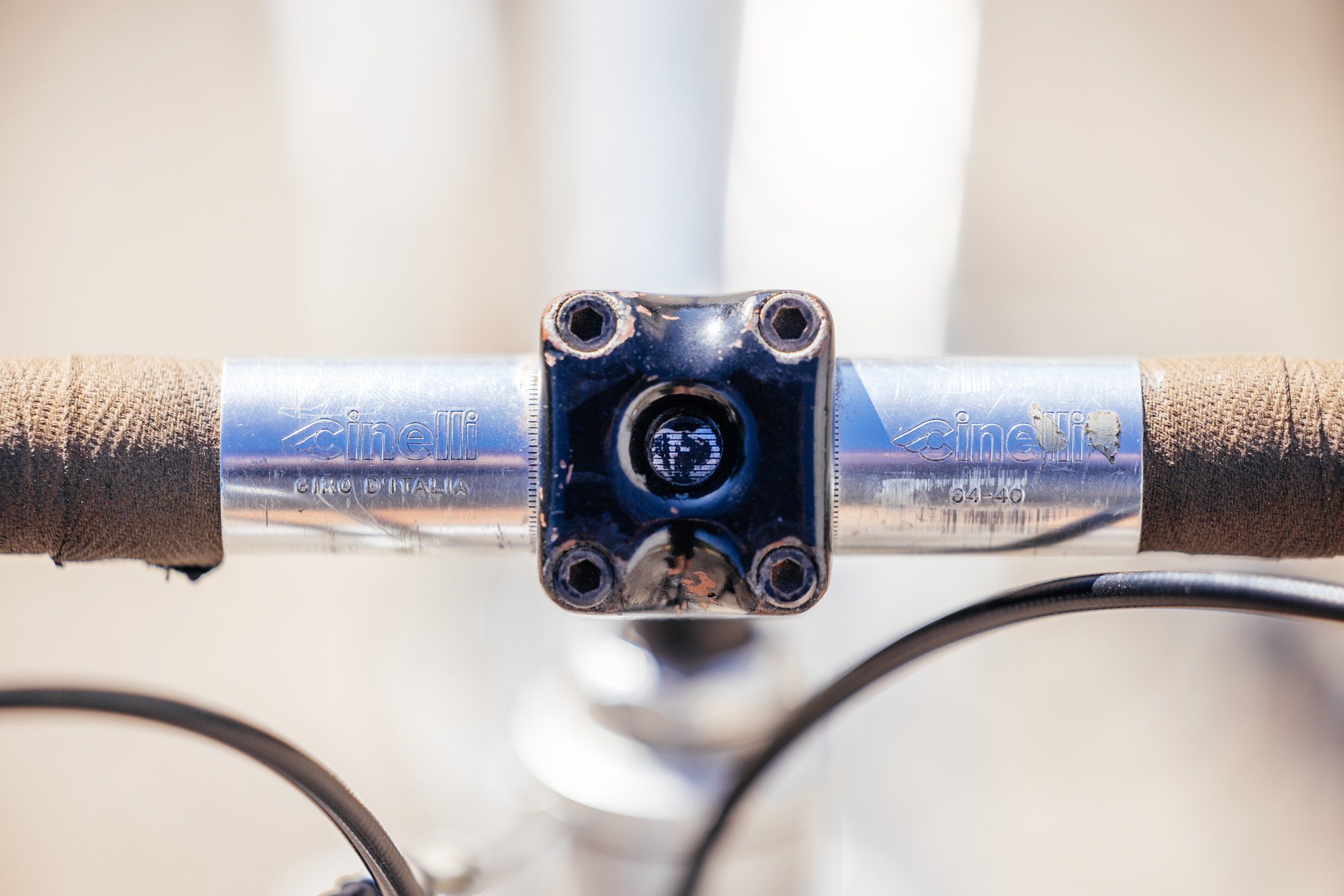
What is this new thing called a mountain bike? In response, you want to be able to point at something that is a widely accepted example. The funky-looking bike with the road bike handlebars isn’t a good candidate, but Charlie had his technical reasons for this alternative cockpit choice. You might make the argument that the straight, wide bars off a Husqvarna give more control for high-speed runs down Repack. He would reply that he selected his bars after much careful thought and found them to be the optimal choice for the type of riding he enjoys most. That riding would be narrow game trails through very tightly spaced trees. He won’t criticize the bars you prefer for your riding. And with that, the discussion will be over, because you can’t argue over personal preference.
The Search for Materials and Exotic Hardware
Where does one get the materials to make an unconventional bike? Both thin-wall chromoly steel and 6061 aluminum tubing were readily available from the home-built aircraft industry, which also began to flourish around this time. That said, Charlie was working as a carpenter-plumber-handyman at the time and didn’t have the resources to order new stock from places like Aircraft Spruce and Specialty, leaving him to scour half a dozen Bay Area scrap yards. There appears to be one key ingredient those yards didn’t readily have: thick-walled aluminum tubing needed to make headtubes and bottom bracket shells. For this, Charlie relied on Gary Klein, the pioneer of aluminum road bikes. Before Klein Performance Bicycles was in Chehalis, WA, the company had started out on the family farm in San Martin, just south of the Bay Area.
Charlie would plead with Gary for small amounts of this thick tubing while agreeing to meet him along Interstate-5 for the hand-off during Gary’s trips north. Of course, this era also followed on the heels of the successes of the US moon-shot space program, which saw the development of exotic materials and hardware to increase strength and reduce weight. While the bike industry has always valued these characteristics, it didn’t have the resources at the time to develop them on its own. Among other places, Charlie would frequent the Alan Steel scrap yard in the South San Francisco Bay, looking for prized treasures you couldn’t otherwise buy. This happened to be where the local aerospace industry was getting rid of surplus materials and hardware.
Among the exotic hardware that made their way onto his bikes were grade 8 bolts, castle nuts, bolt heads drilled for secure wire wrap, titanium screws with three prongs, and aluminum replacement fasteners. For materials, this included titanium sheet metal, titanium rod, ZK60A magnesium alloy, 2024 and 7075 hard aluminum alloys, and high-performance plastics.
CCPROTO: Once Forgotten
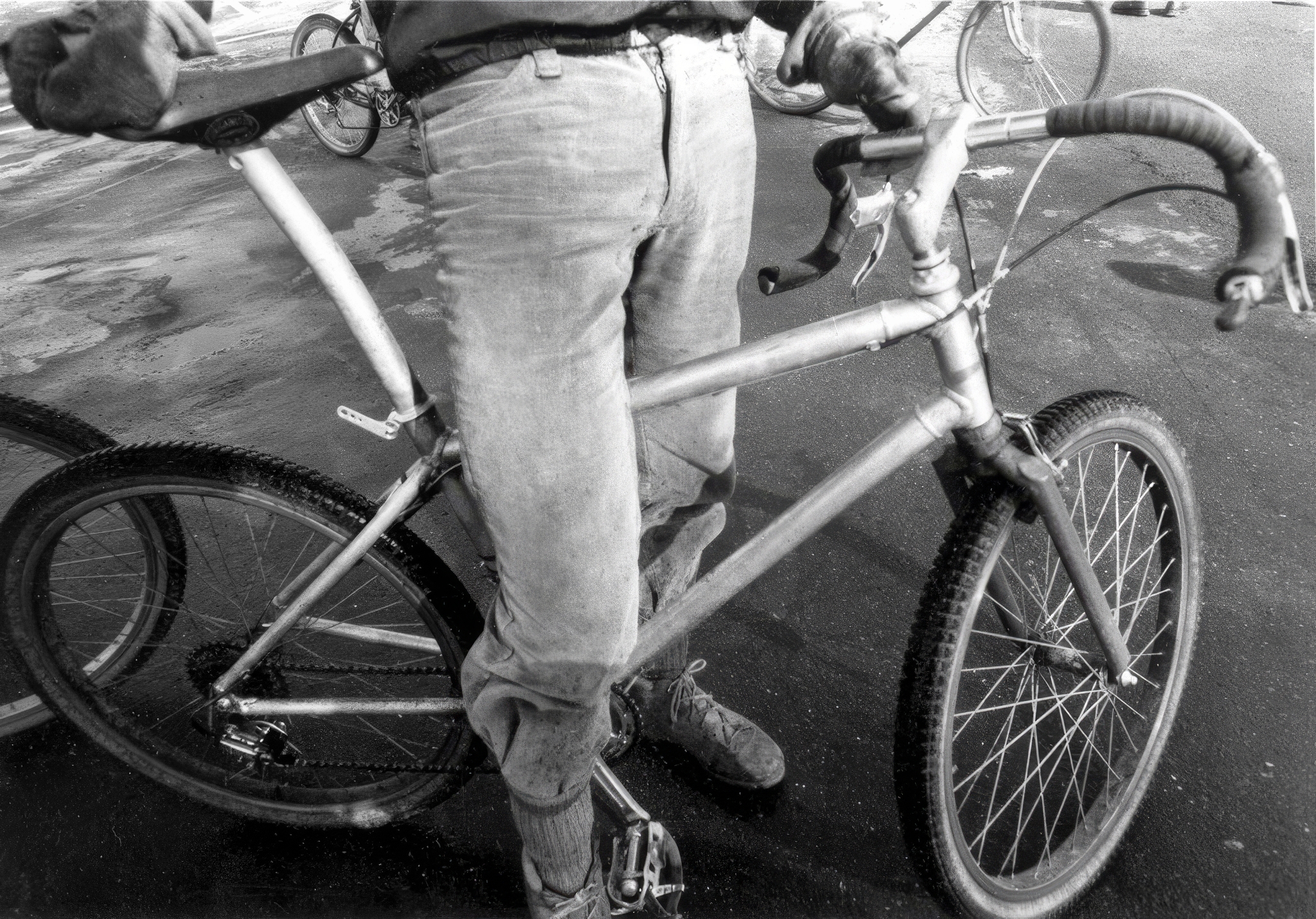
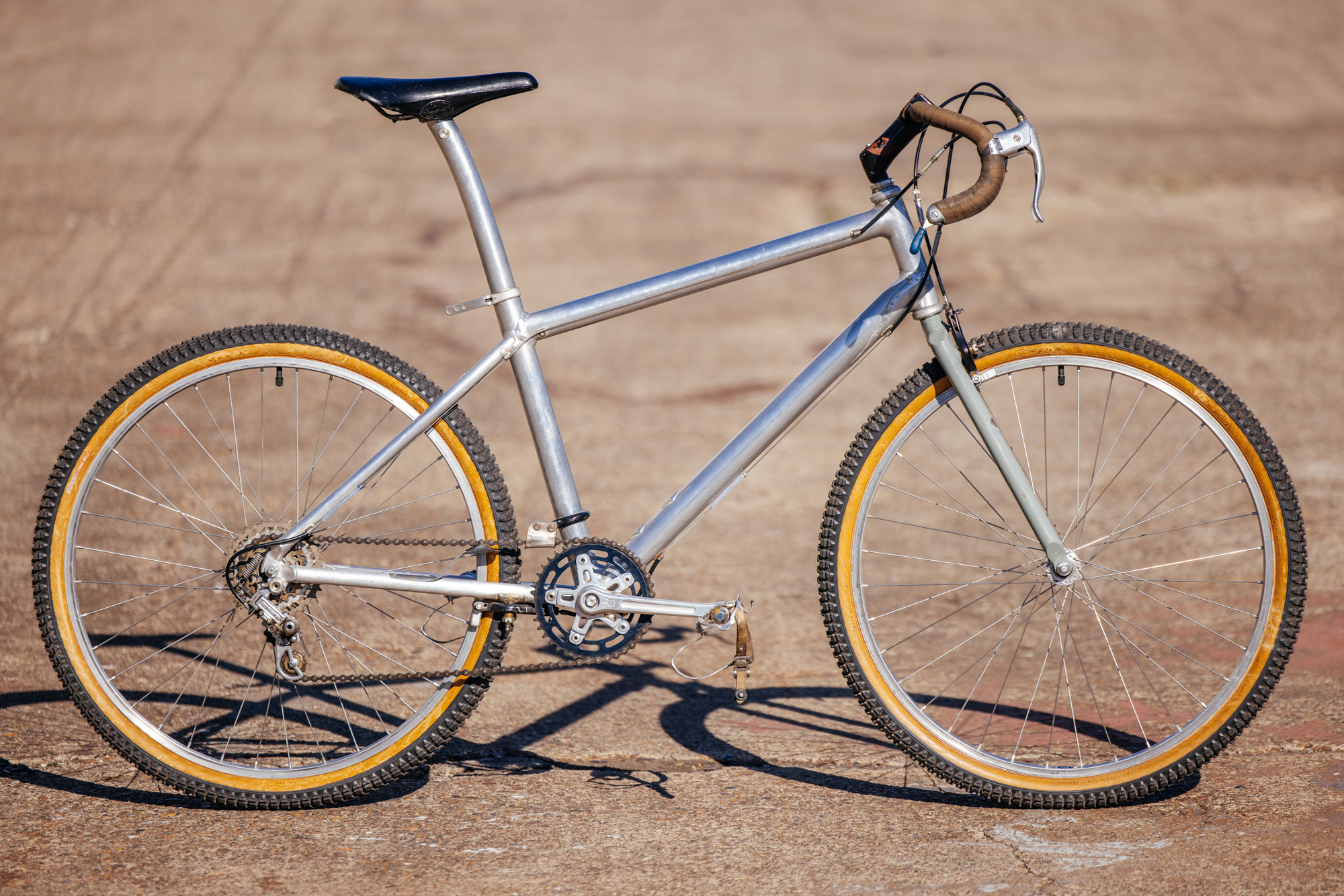
With this background on Charlie, we now take a detailed technical look at the bike known as CCPROTO. The first thing to recognize, as the serial number implies, is that this was an experimental bike that served as a working prototype. Charlie wasn’t about to adopt the accepted geometry of the time, based on Schwinn paper boy bikes, because it was oriented toward stable handling while bombing down hills. An early photo of this bike shows where Charlie cut the headtube off the frame and re-welded it to change the head angle several times.
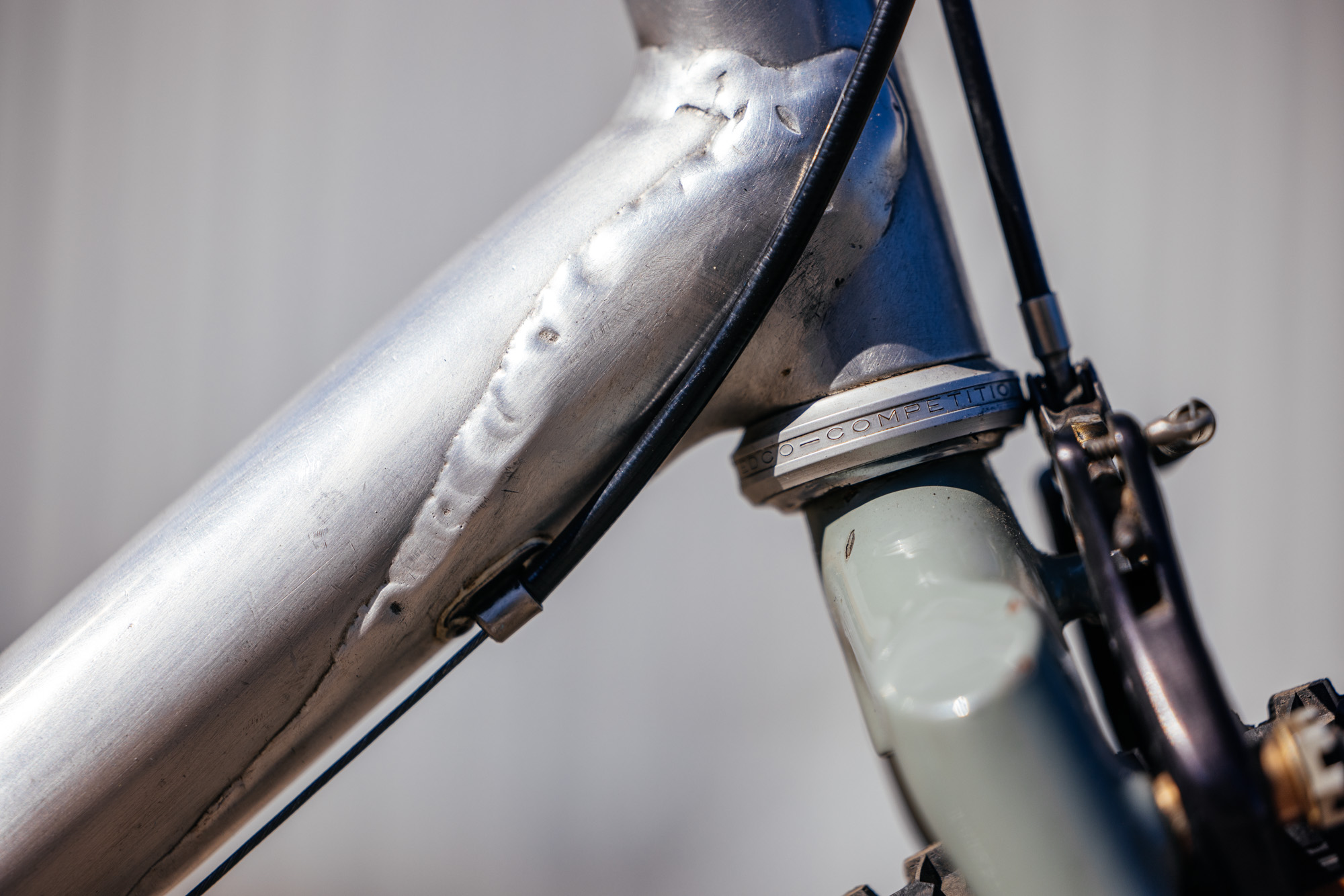
You will also notice from this photo that the bike lacks Charlie’s customary gussets and smoothed welds at the headtube, which were added later. At some point, the bike was loaned out to a visitor who ran it into a tree, and the fork was damaged beyond future use. After Charlie moved on to his next bike, CCPROTO eventually ended up with a Fairfax local, in some form. When Don Cook requested that the bike be restored and put on display at the Mountain Bike Hall of Fame in Crested Butte, Charlie had to recover the dispersed pieces and make repairs. As much as this sounds like heresy, this was a common fate for the earliest bikes before people recognized their historic significance.
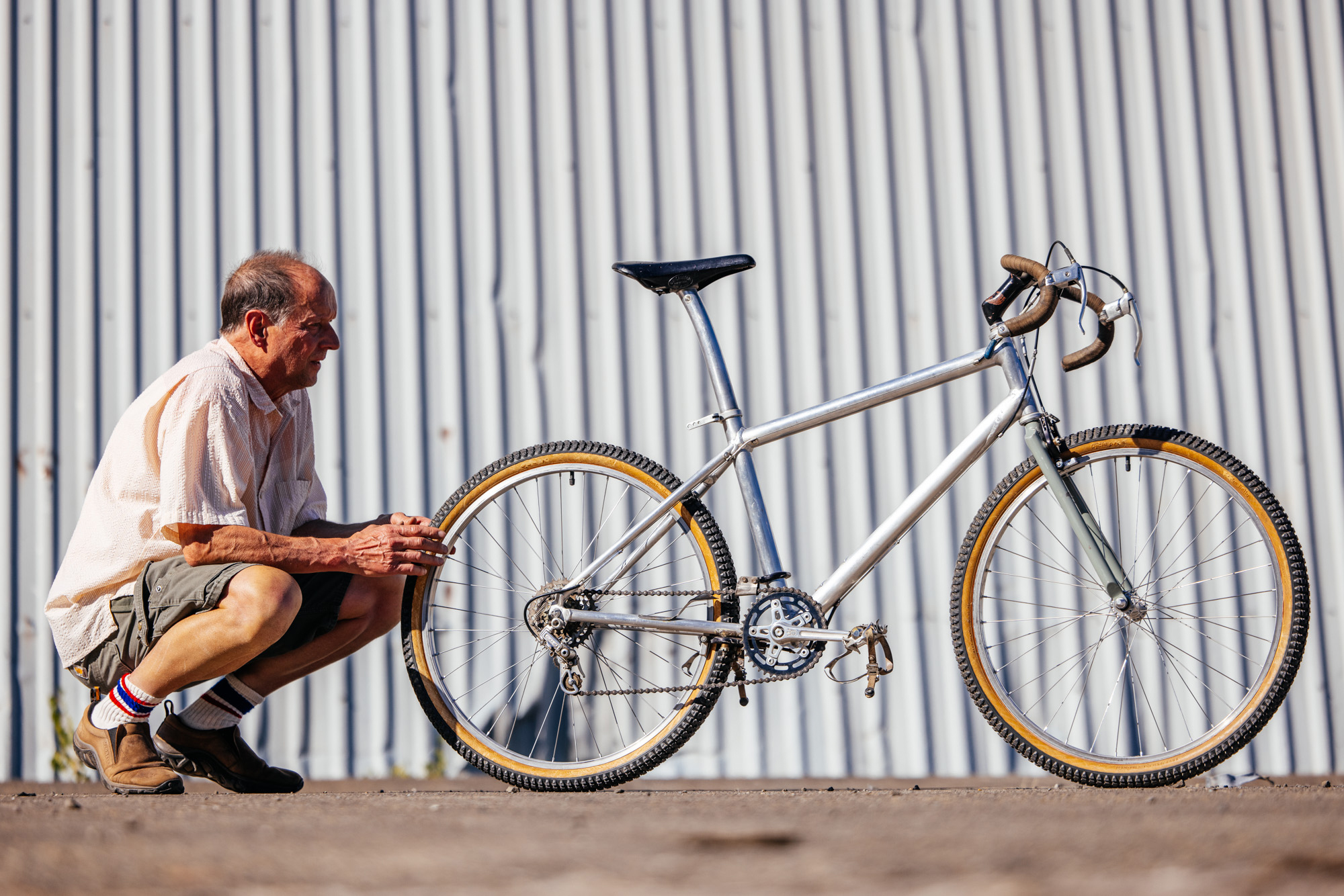
Thanks to Ron from King Cage for the spotting!
Walking Around the Bike
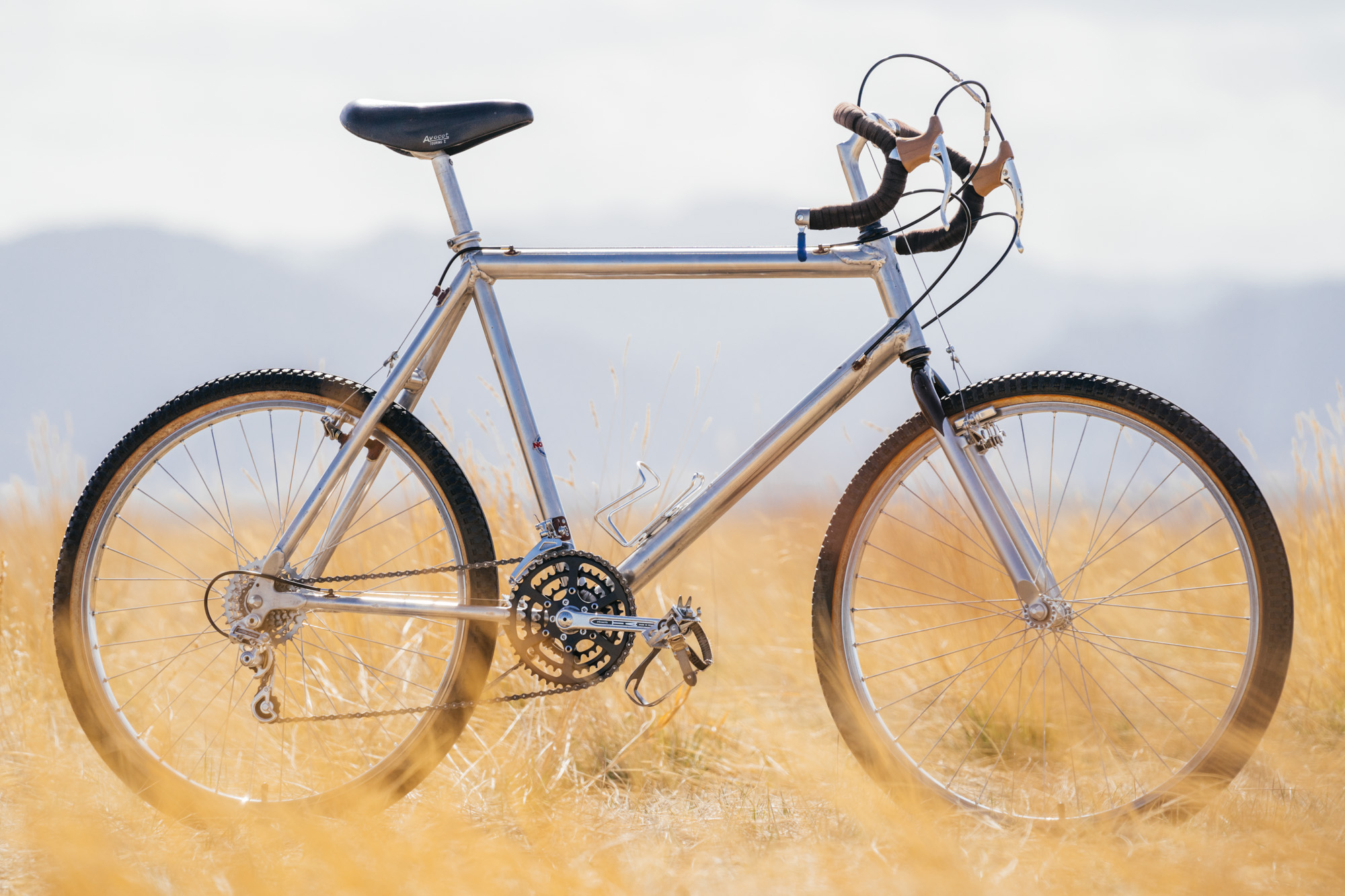
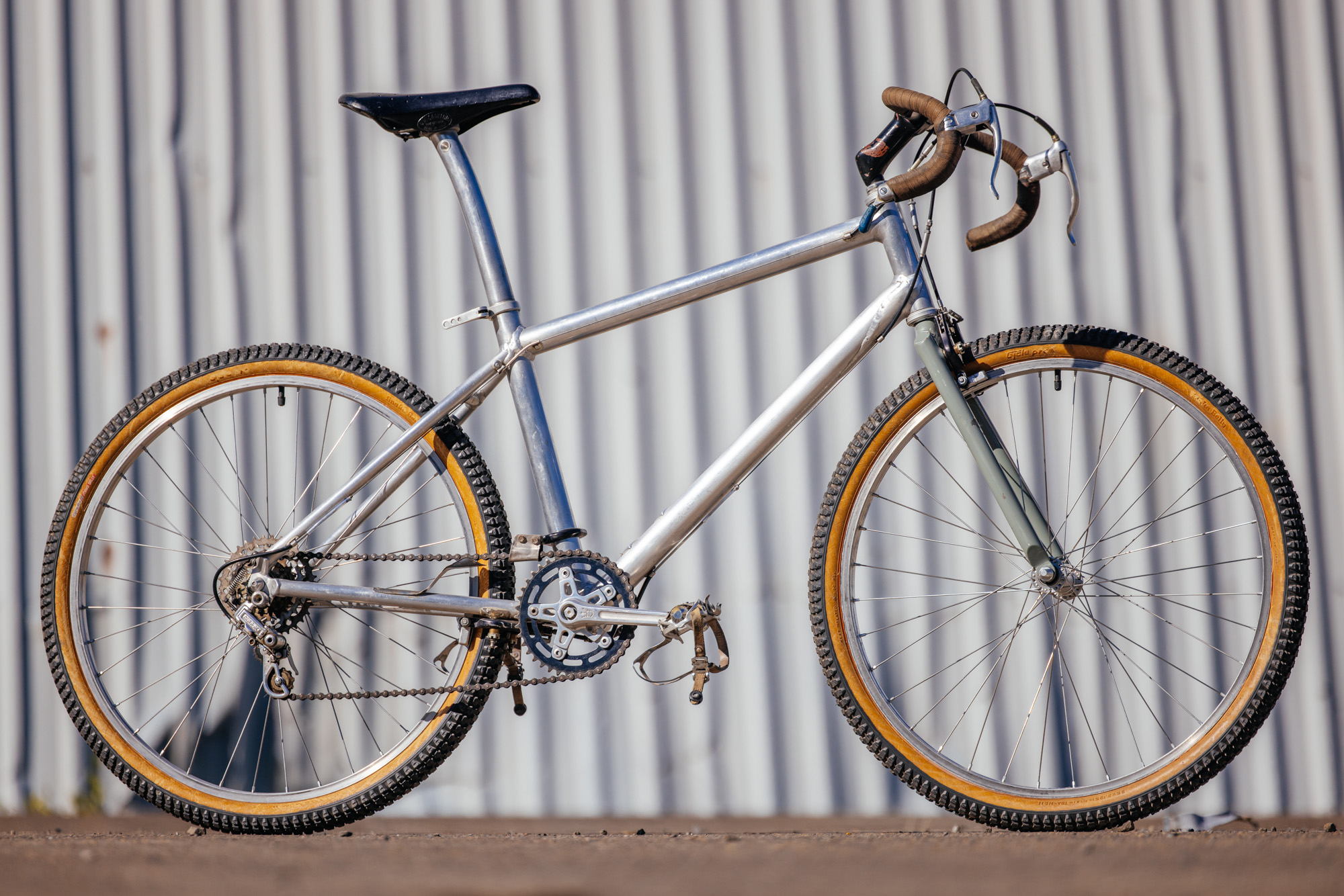
Forget about the obvious visuals offered by the drop bars, the big aluminum tubes, or the sloping toptube for a moment. Something else belies the bike’s age. Charlie knew from the outset that he had to shorten the geometry of the klunkers, which he felt had a wheelbase too long and a bottom bracket too high for more than downhill riding. Even the early mountain bikes (Breezer, Ritchey, Lawwill), with their chainstays of 18 inches or longer, were prone to slipping on steep climbs. Instead, Charlie went with 17” chainstays and a proportionally short front end to maintain the weight balance. The under-42-inch wheelbase he arrived at would become the de facto cross-country standard through the late 1990s until the advent of long travel suspension and bigger wheel formats. Through a process of experimentation, he got to a result which he described as “cerebral.”
Unfortunately, almost no one else was ready for his vision at the time. When he started to make frames for other people in 1981, they tended to request klunker geometry. Steve Cook wanted his Cunningham bike (serial #1) to be an aluminum Ritchey, and the wheelbase ended up at 44 inches. It was 5 years later that some acceptance of CCPROTO’s geometry took place, and Charlie would designate those bikes as “Racers,” whereas the longer bikes were known as “Indians.” Ironically, it would be more than 10 years before the company Charlie helped found, Wilderness Trail Bikes (WTB), would release a production bike with this same “Racer” geometry, with the Phoenix becoming known as a steel Cunningham.
A Fork to Resist Hideous Flex
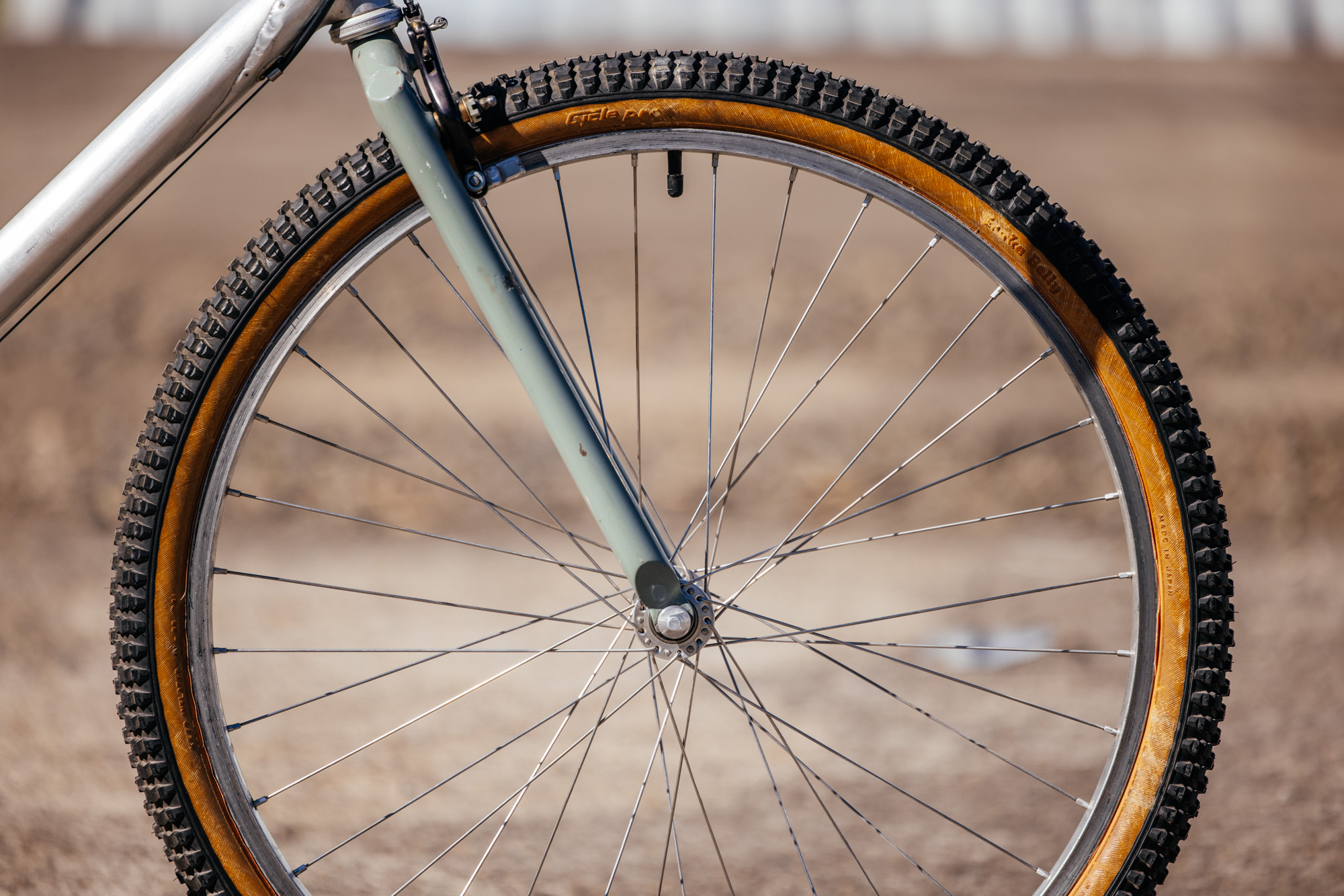
Charlie considered the klunker frames to be “hideously” flexy, and the plate-steel forks exceptionally bad because of their minimal cross-sections on the blades. The challenge for custom frame builders in the early days was to make forks with clearance for fat tires like the 2.2-inch Uniroyal Nobby. Fabricating biplane forks was the solution for many, but they still relied on thick steel to keep the twin plates from twisting in torsion. Charlie’s solution was to use a segmented tubular fork crown to rely on hollow structures as much as possible. This also allowed him to use a 1-inch-diameter butted top tube, cut in half, to make a pair of lightweight legs. Even though the legs don’t taper, the wall thickness varies to give a compliant fork. Charlie sourced the tubing from Santa Rosa frame builder Jeffrey Richman, who was known for tandems and also made a few very early mountain bikes at this time.
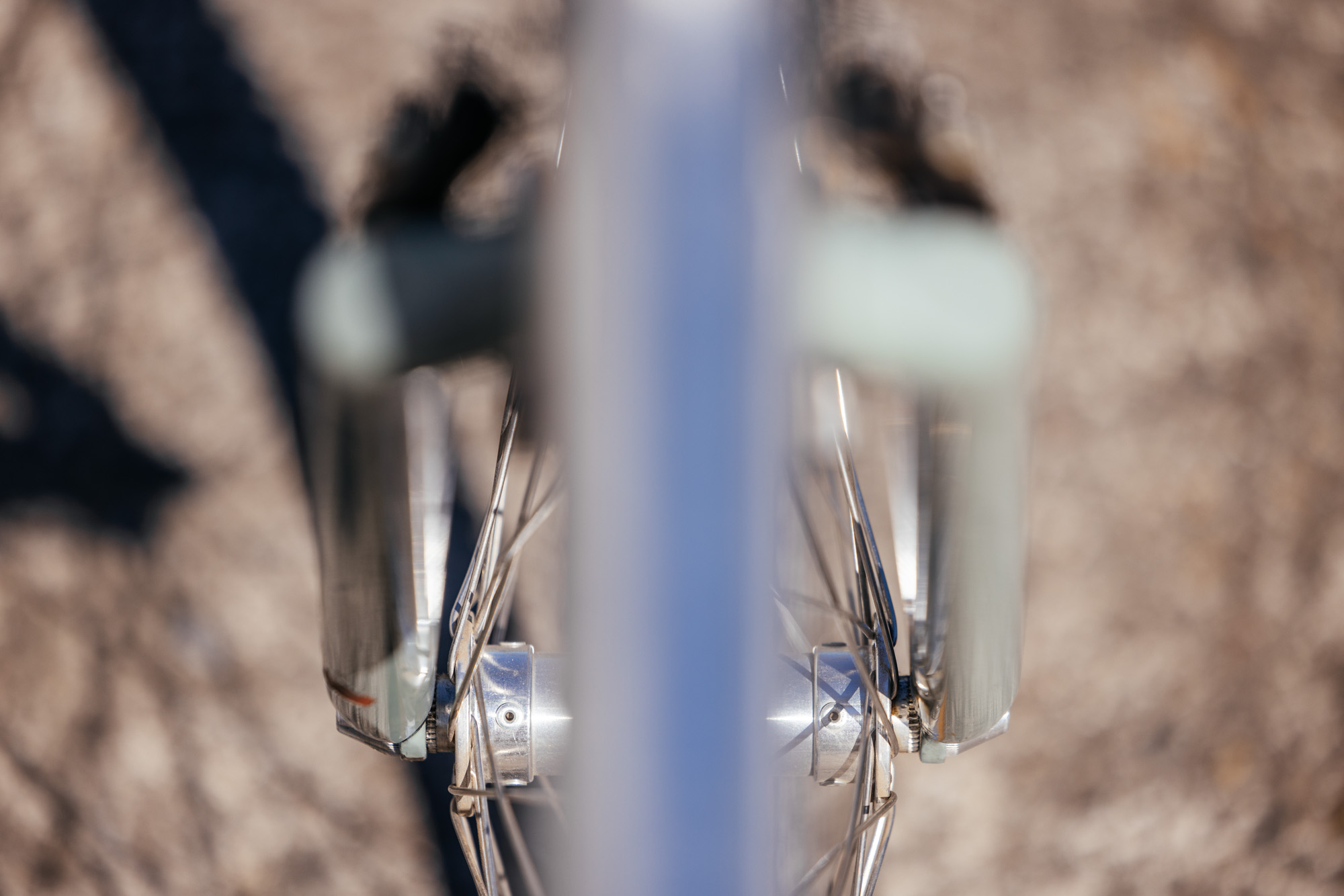
Rather than slotting the bottom of the fork legs as required by skinny tapered blades, the dropout plates were brazed to the inside edge of the 1-inch tubes, so there is as much clearance as possible on the inside for spokes. Why was so much clearance needed? Because the fork dropout spacing is an outstanding 115 mm wide, making for a very early example of what we now call Boost spacing. When you are making your own fork and configuring your own hub, you have the freedom to make the best combination of the two.
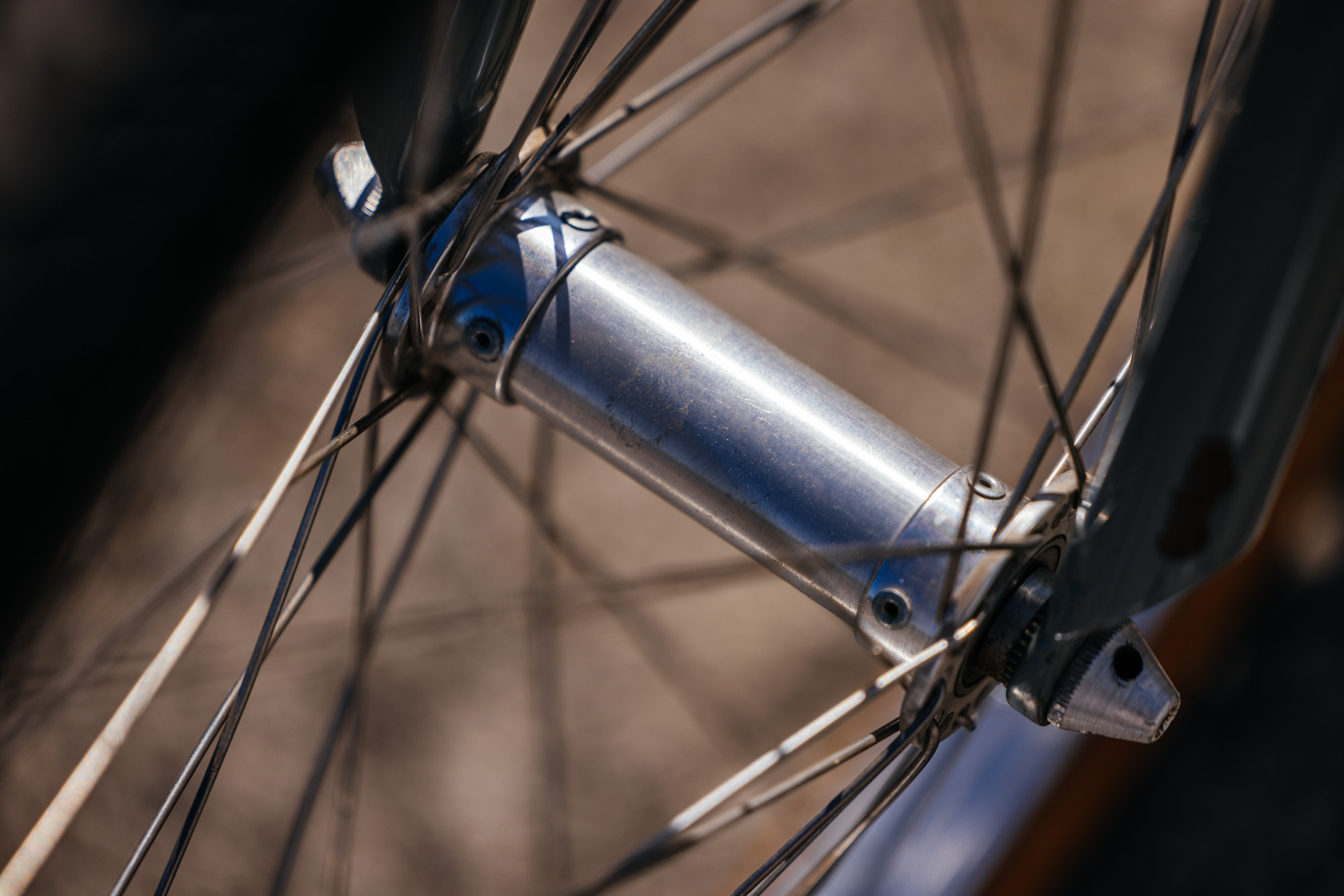
Granted, you would be out of luck on the trail if you wanted to borrow a wheel from someone. Charlie had two reasons for the wide hub front hub: better spoke triangulation for a stronger wheel and more vertical compliance for a softer ride. The hub is a three-piece Hi-E Engineering modified with a custom wide center shell held with rivets. The hub is secured with a “Slo-Release” skewer that requires insertion of a 2-inch titanium pin to twist off the conical nuts. Charlie often harvested the 10-32 threaded rods that held electric motors together to make his skewers because they had a strong rolled thread.
Fiendish Brakes
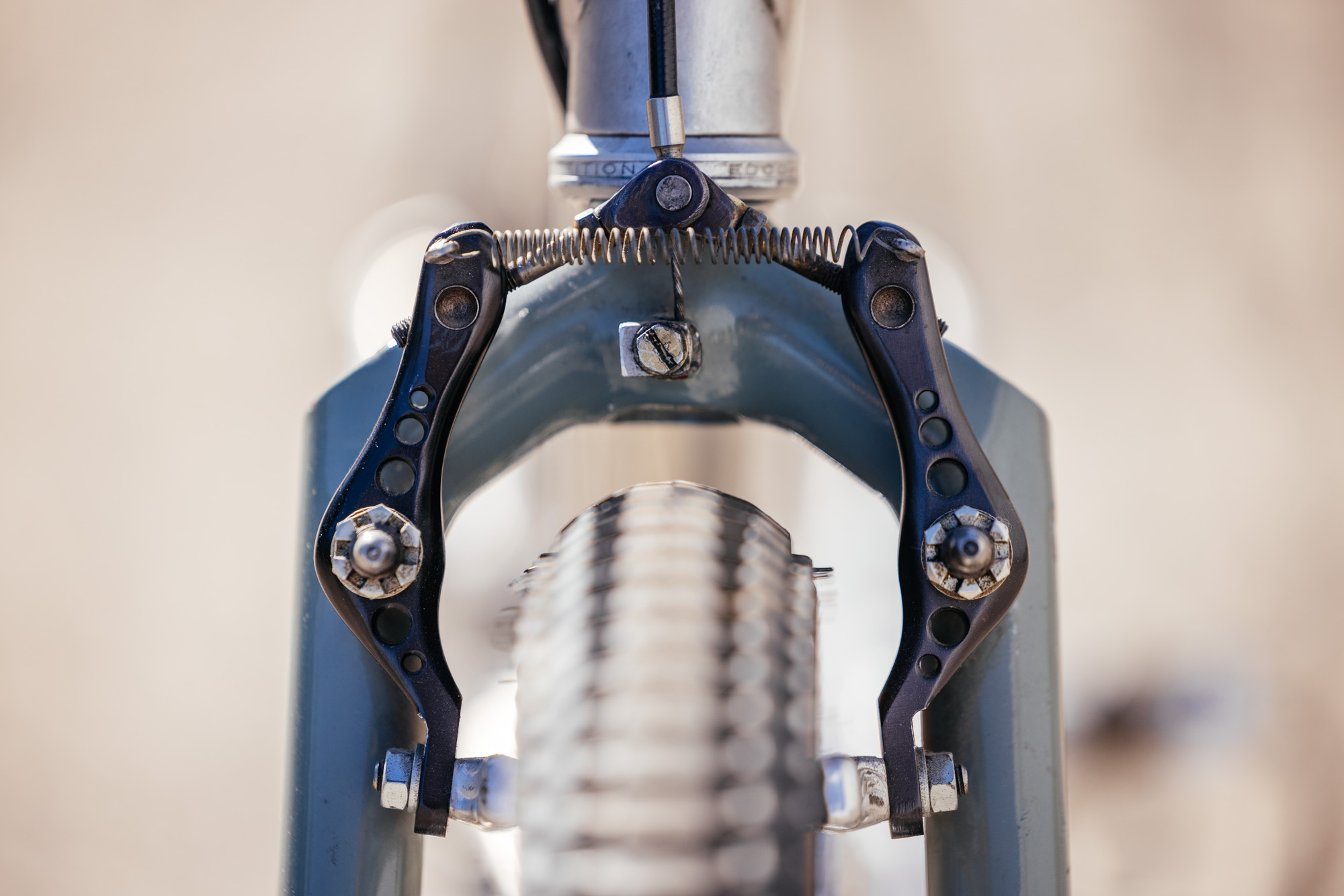
A key to going very fast is to be able to stop very well. Coming off coaster and drum brakes on klunkers, the Mafac tandem cantilever brake was a lightweight replacement but had its limitations, namely flex and a leverage ratio that decreased with cable pull. Charlie put tremendous thought into the design of his toggle brakes and addressed flex with the mounting location. Unlike cantilever brakes, which pivot below the rim, Charlie was keen to have his brakes pivot above the rim, where they are closer to the stiff crown or closer to the end of the stays. The end of the brake cable anchors to the crown of the fork or the frame, so effectively the cable housing is pushing the actuation linkages.
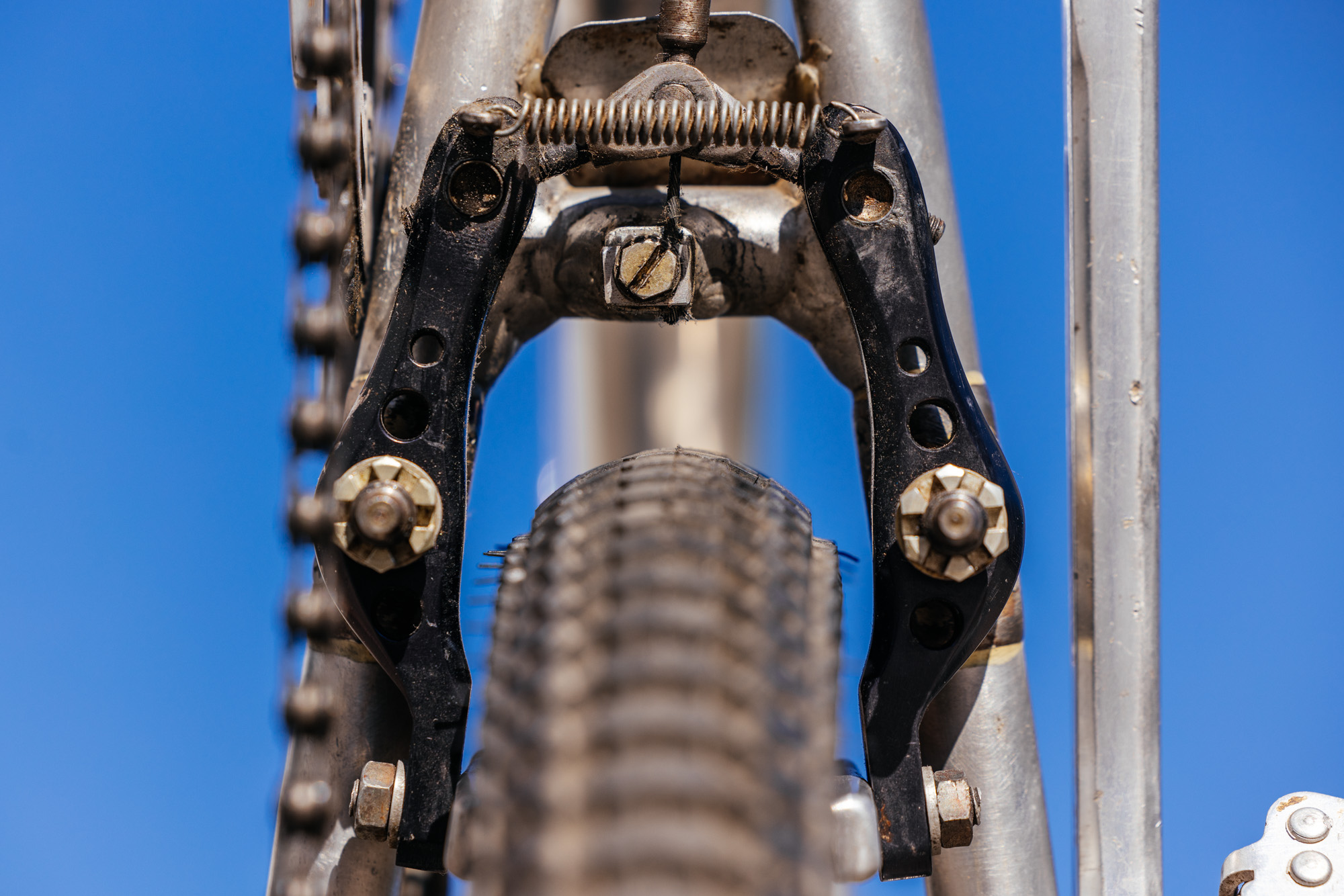
The more you pull, the higher the leverage. The linkages are adjustable turnbuckles to ease setup, and the centering of the brakes on the rim is done by the clamping angle of the cable. The brake pads are Mafac, to which Charlie welded threaded studs to adjust toe-in. The arms are secured with aircraft castle nuts, and a fitting on top of each mounting boss feeds grease inside the pivot bushings. It’s worth noting that these elegant brakes were cut out on a bandsaw and hand filed to their organic shape. Holes were made on a drill press, not a milling machine.
When asked about this heroic effort to make brakes in a form far beyond function, Charlie described it as a fiendish effort. There are only six early Cunningham bikes that got these brakes, and as much as this was Charlie’s ultimate brake, it was impractical to make and not customer-friendly to maintain. Ultimately, Charlie would develop the Lever-Link on the same principle and retrofit it to his production Rollercam brakes.

Drop Bar Controls
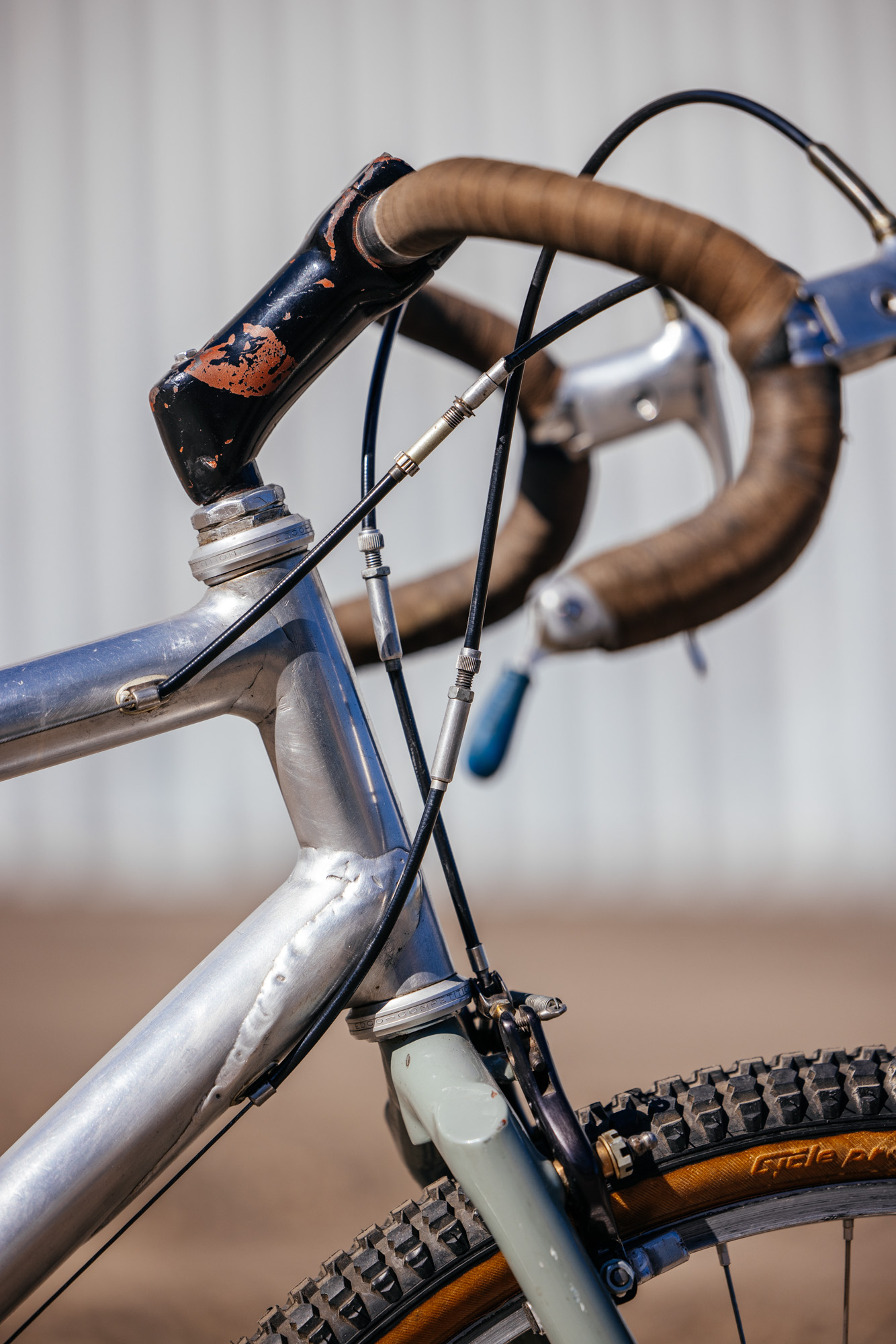
Charlie carved the hollow stem from a block of ZK60A magnesium alloy, which necessitated a four-bolt face plate design to accommodate the curves of the handlebar, and paint to keep the magnesium from corroding. A tiny alloy bolt Charlie made tightens the quill.
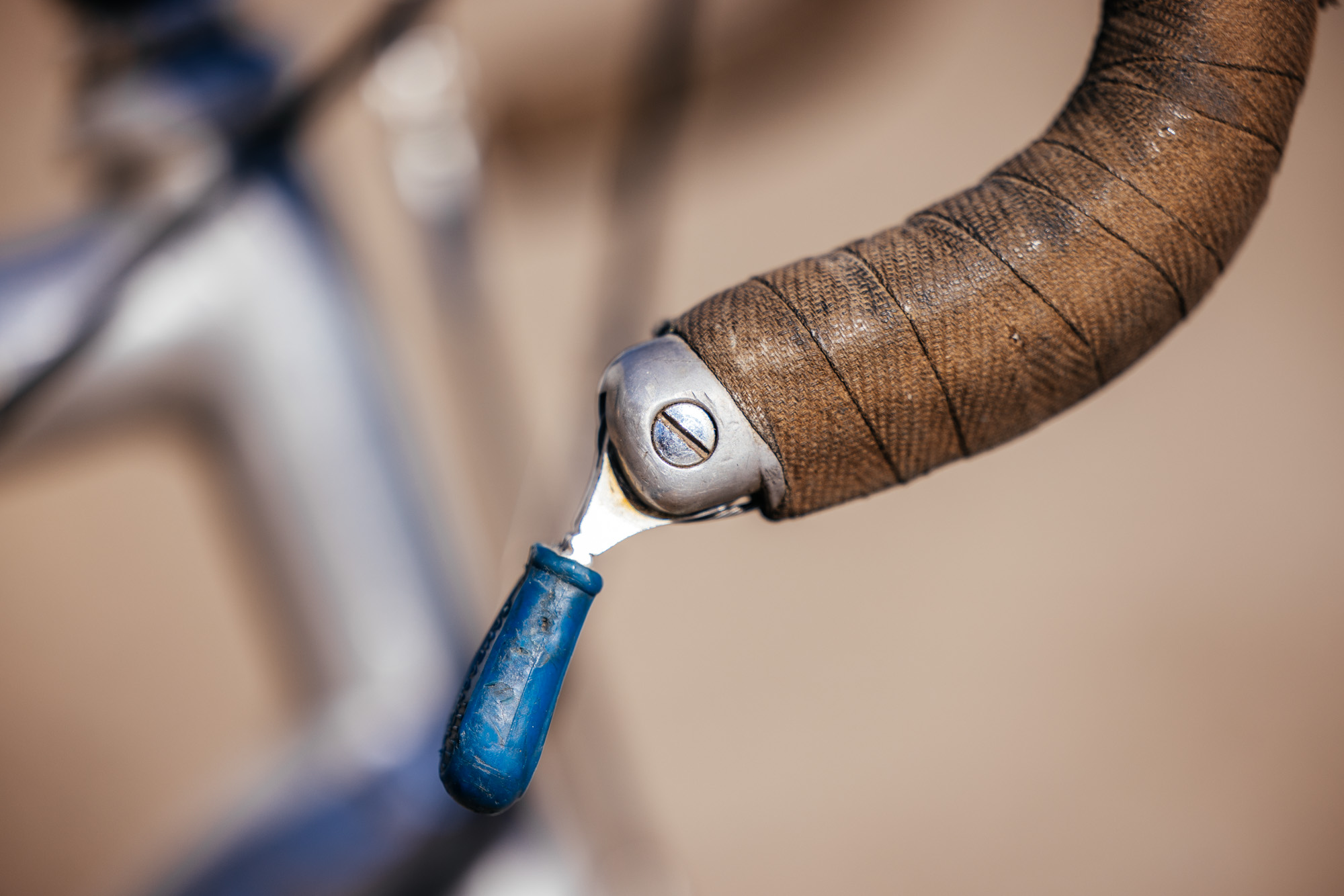
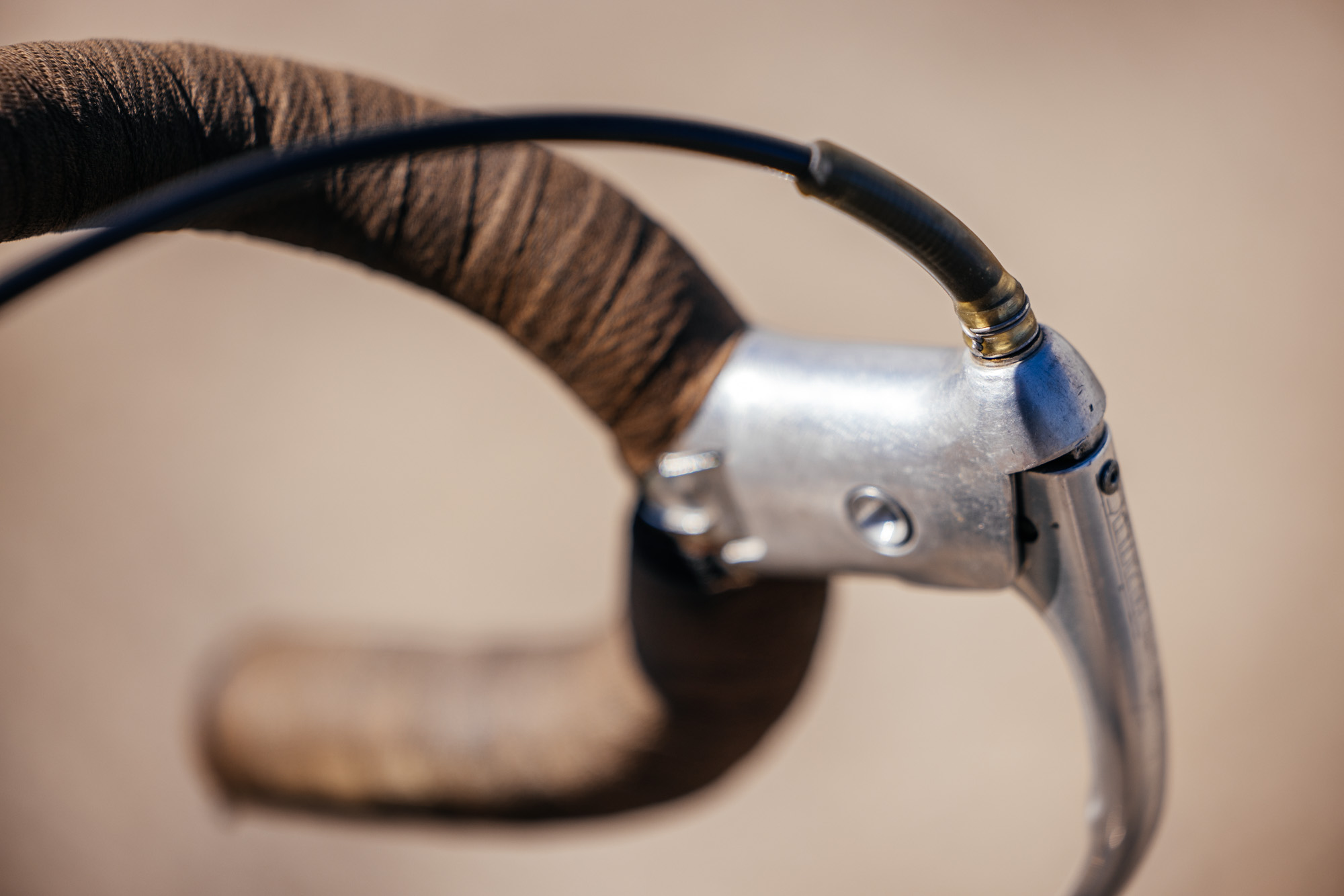
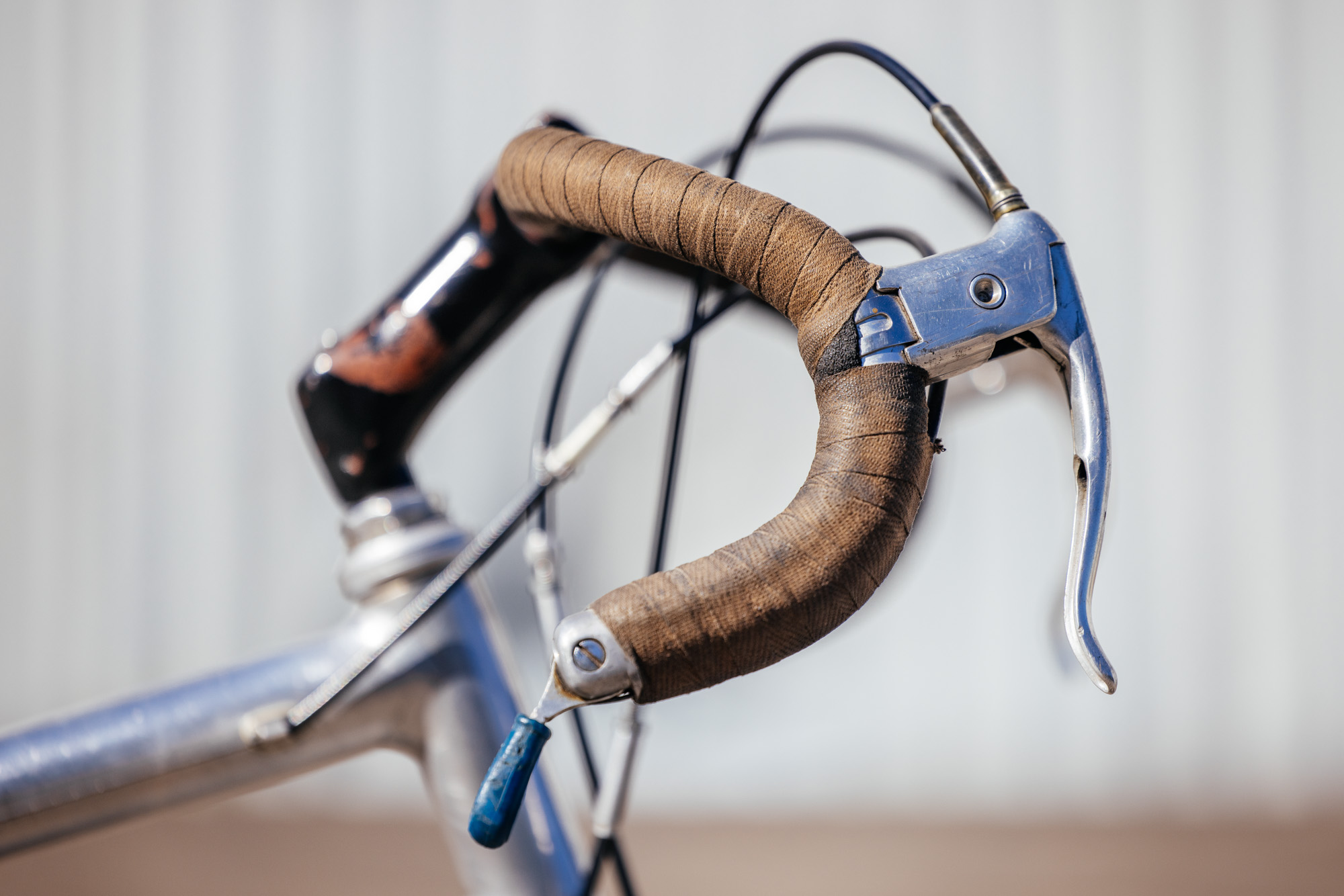
For shifting, Charlie preferred Campagnolo bar-end friction instead of the popular Suntour Barcon Mighty Click, probably because it was easier to fine-tune instead of being stuck between the small clicks. Compared to motorcycle brake levers used at the time, road bike levers didn’t pull a lot of cable, but made up for it with high leverage. The cable path of the non-aero design is as direct as it gets, and a characteristic Charlie preferred on every bike he ever owned. The early Suntour Superbe levers are simple and light, and made even lighter by foregoing the rubber hoods. On the left lever, he riveted on a small tab of metal to adjust the reach position to be closer to the handlebars. Charlie fashioned strain reliefs for the cable housing that exit the tops of the levers out of thick Tygon tubing and safety-wired them in place. He made his own in-line cable adjusters using threaded barrels from Dia-Compe and Weinmann. Charlie consistently used lightweight Edco Competition alloy headsets on his bikes until Wilderness Trail Bikes utilized Charlie’s Grease Guard design to develop a headset with Chris King.
An Ordinary Looking Frame with Many Unique Details
We can say the frame looks ordinary, but only by today’s standards. At the time, the oversized tubes, visible weld beads that were later smoothed during restoration, riveted steel attachments, and a sloping toptube for a stiff, compact frame with generous standover were all jolting to the senses. Compact to the extreme: Charlie rode the bike with more seatpost and tubing showing above the frame triangle than below. This was only possible because the seatpost diameter is a stunning 1-3/8 inches (35 mm), with a custom bend to dial in the saddle position.
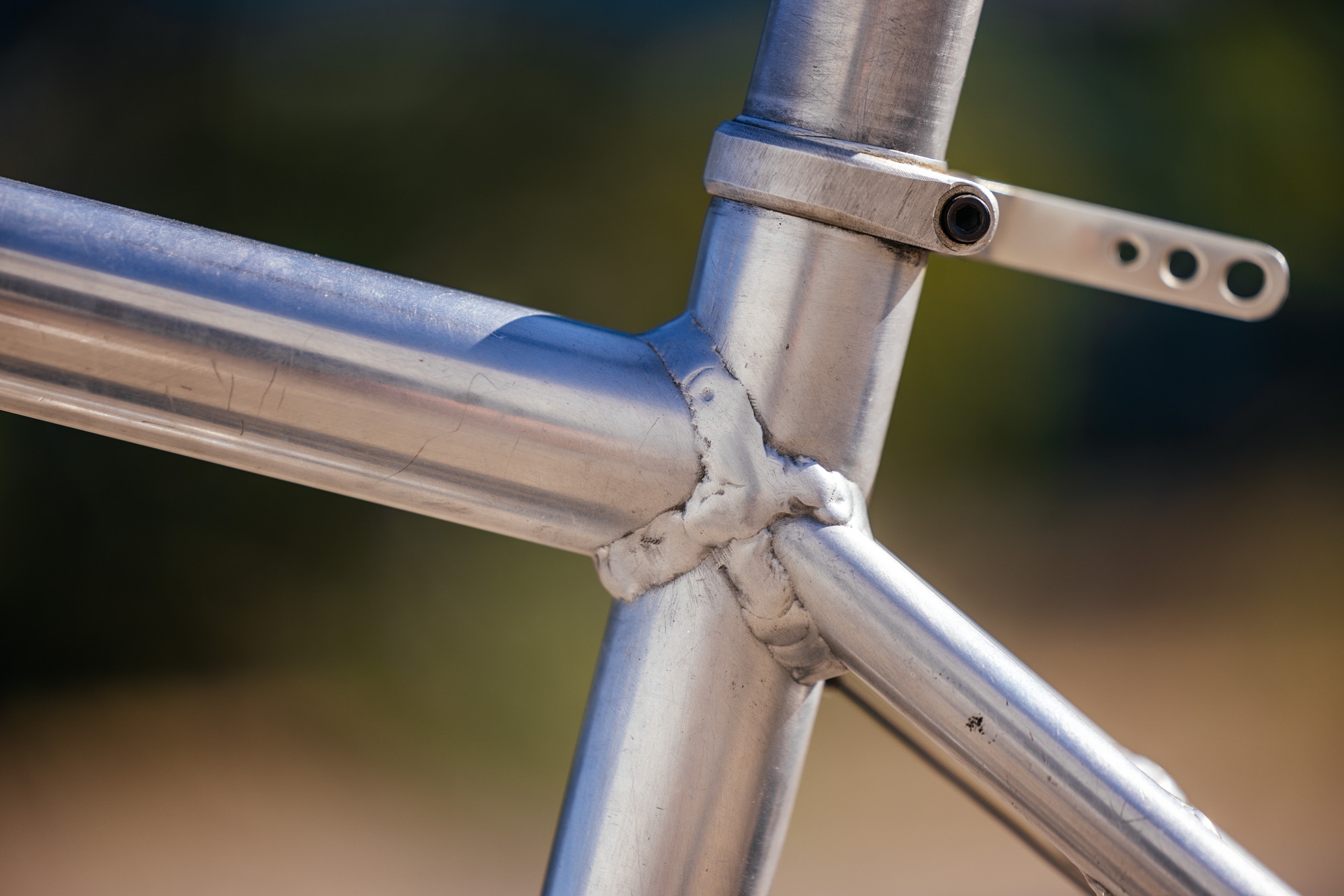
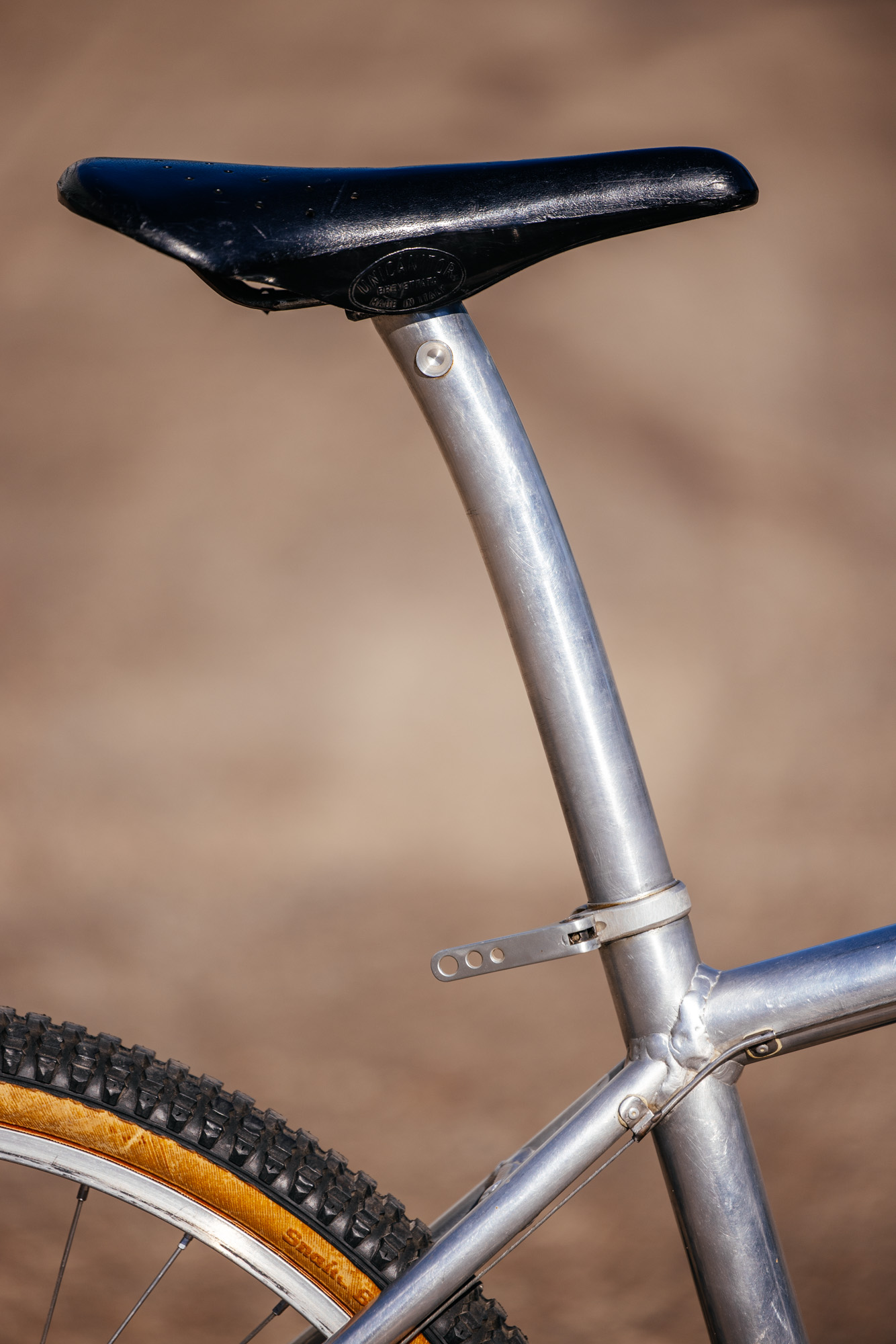
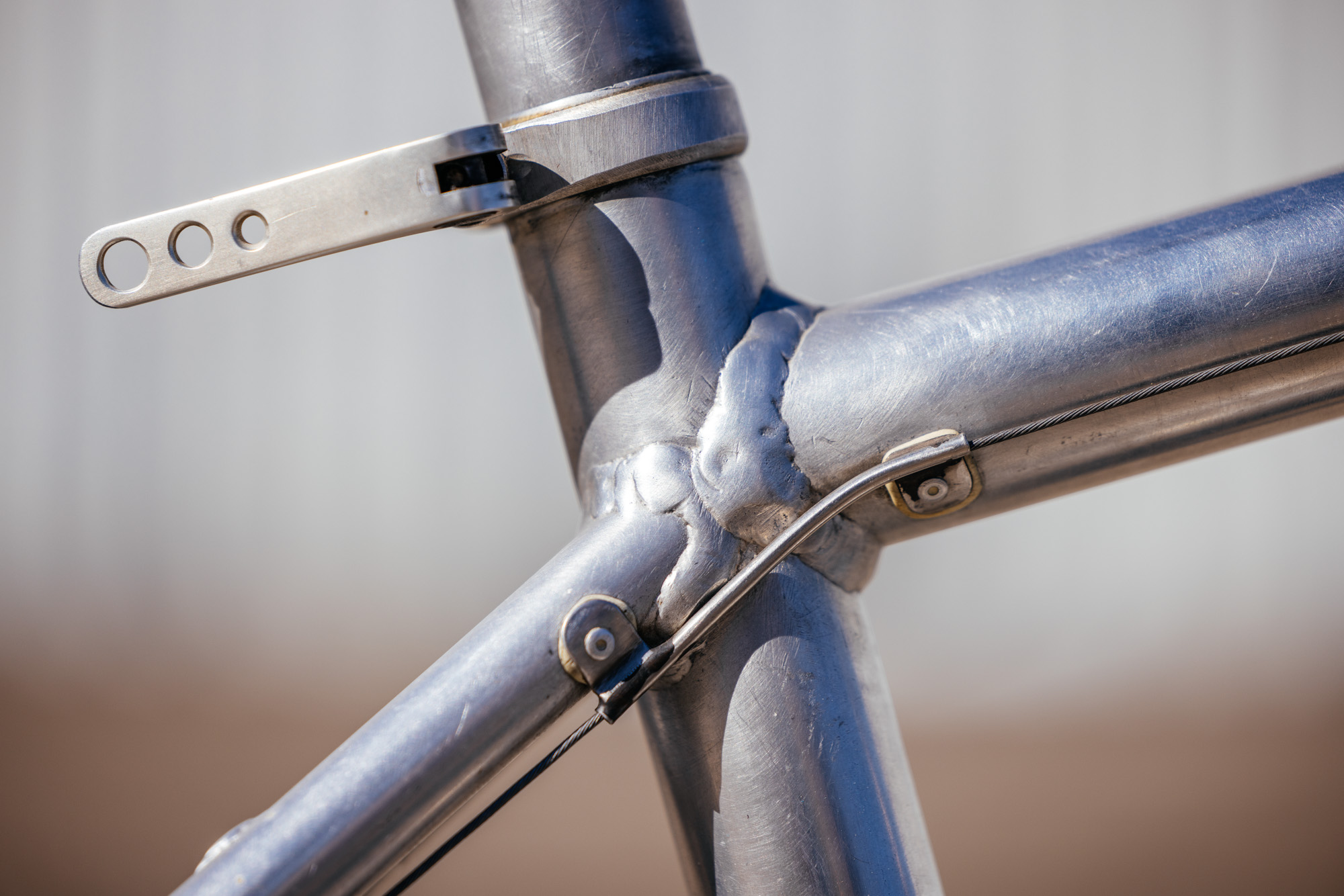
A single bolt at the top holds the saddle at a fixed angle, which is machined into the post, with the rail clamping pieces made of magnesium to save weight. Charlie consistently preferred minimalist Unicanitor plastic saddles without padding and ground down the rails for more compliance. The seatpost quick-release Charlie made is perhaps the earliest example of an external cam design for bicycles, which would later be popularized by Ringlé and Salsa. It requires a hard 7075 alloy and anodizing to function smoothly.
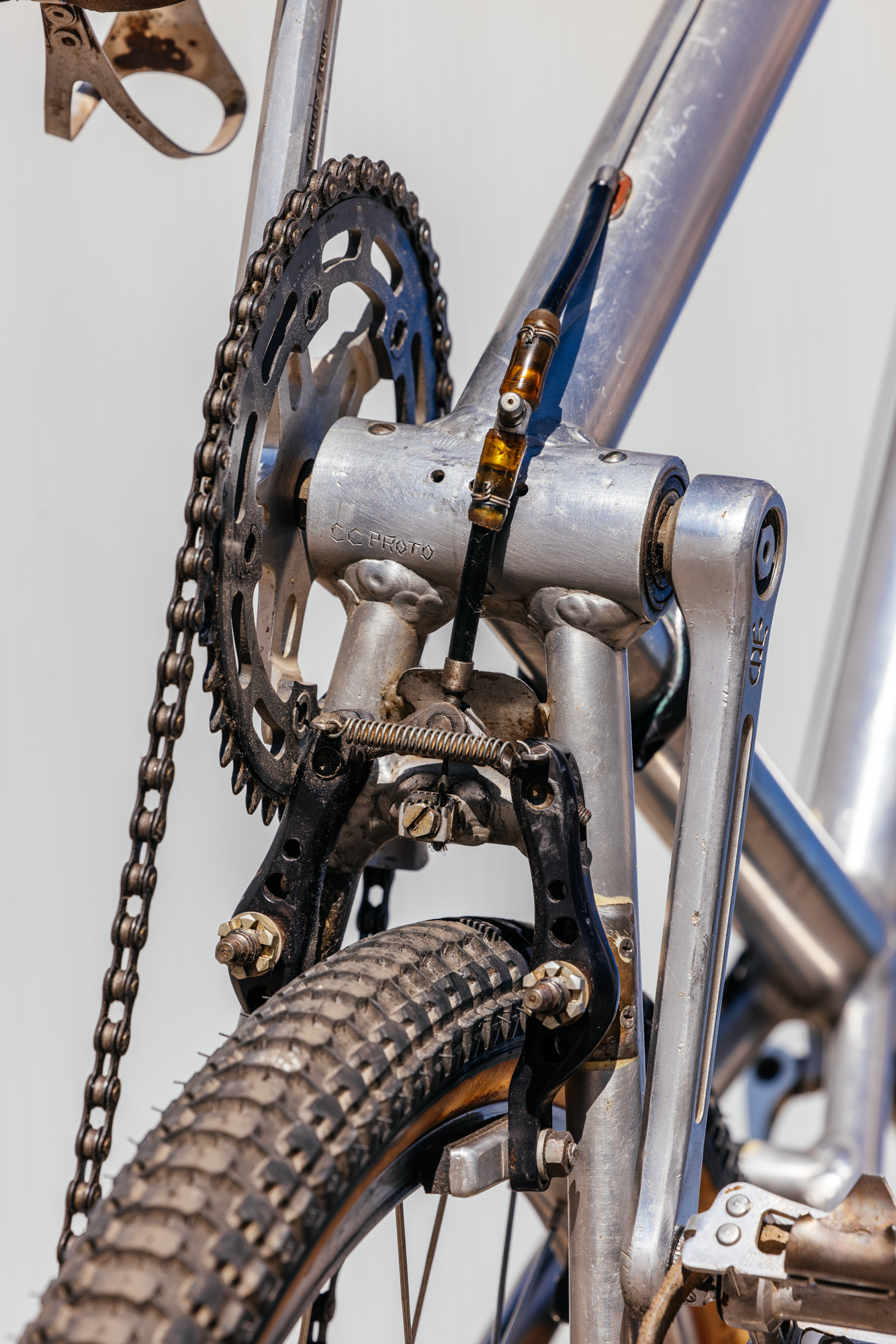
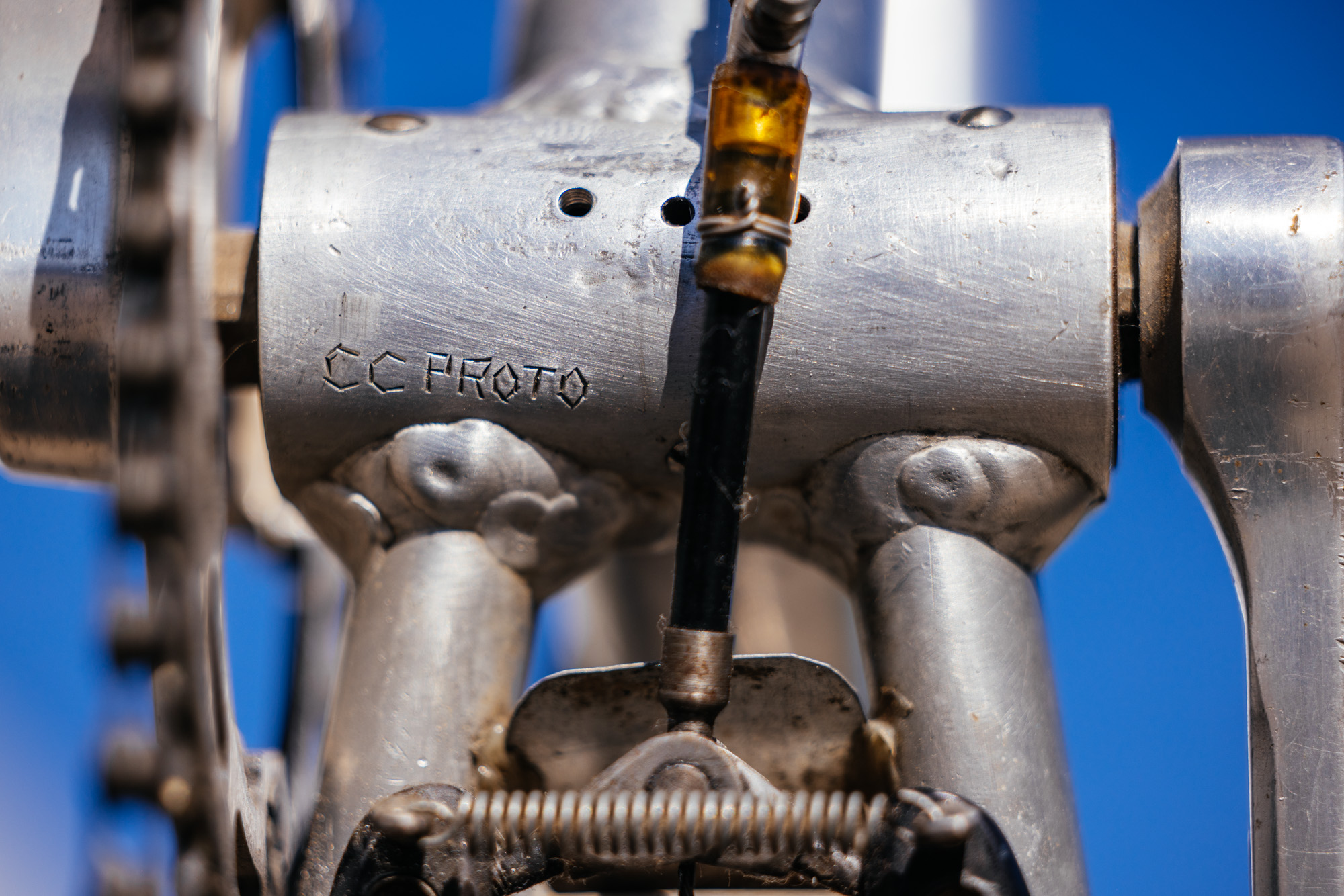
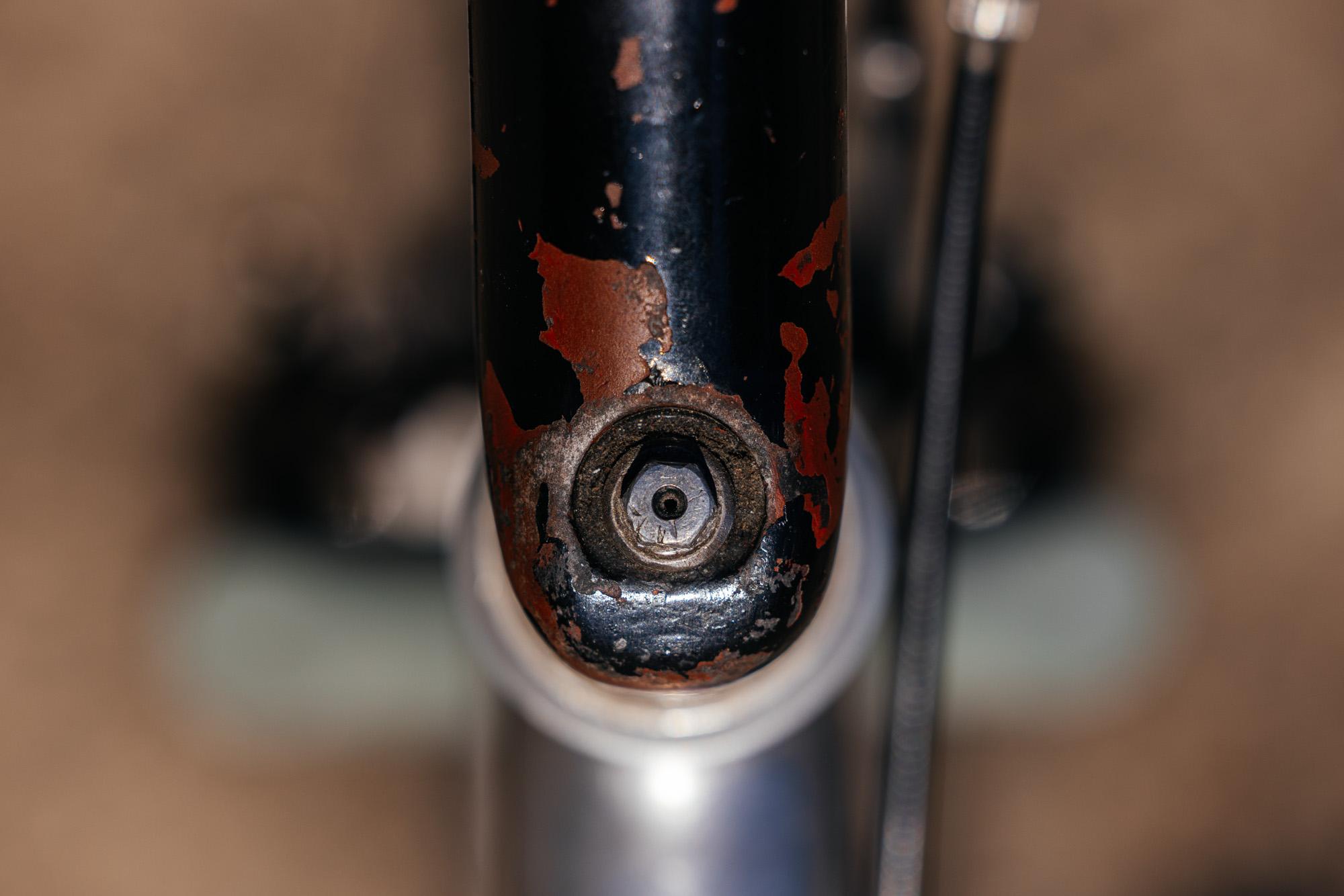
Charlie was adamant about having as much support for the bottom bracket spindle as possible, machining his shell to be 86 mm wide when the norm was 68 mm. With just millimeters of exposed spindle, this meant some of the tapers were captured inside the bearings. The weight of the bottom bracket shell (and the headtube) was reduced by thinning the walls on the inside away from the bearing fits. External ports for injecting grease into the press-fit cartridge bearings are accessed by removing the flat-head screws on the bottom bracket shell. The rear dropouts are minimalist in size to take advantage of the strength-to-weight ratio of the chainstay and seatstay tubing as much as possible. The dropouts are rearward-down facing, so the derailleur attachment is in front of the axle slot and less prone to bending. Vent holes in the dropout plates were sealed off after welding with epoxy and rivets.
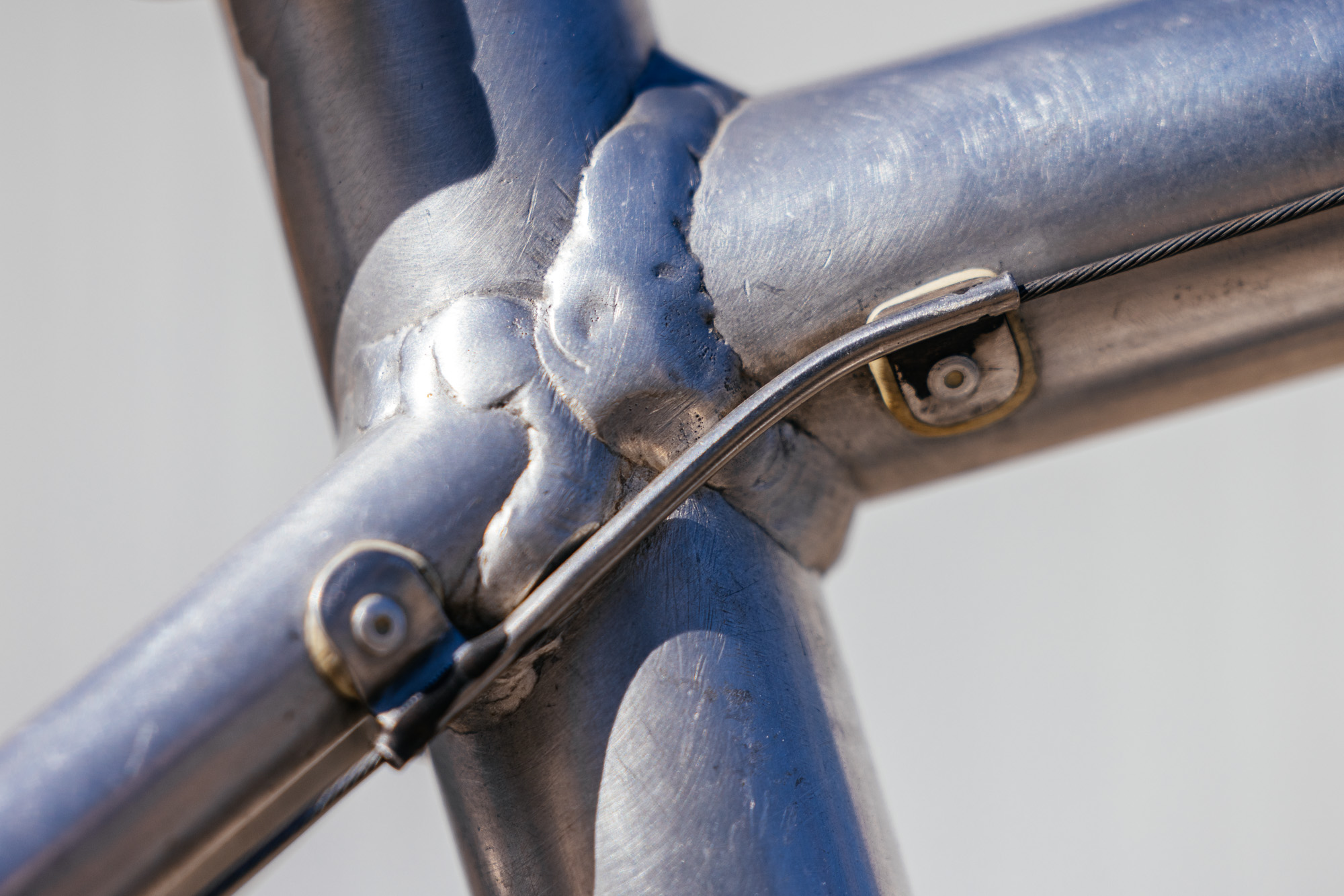
Cable guides were silver brazed together from stainless steel parts that Charlie fabricated and attached to the frame with two-part epoxy and rivets. The rear brake bosses were fabricated using 5/16-inch aircraft bolts for strength and wear resistance and epoxied and screwed in place. To reduce drag on the rear shifting, Charlie added a protective sheath that slides with the rear derailleur cable to prevent contamination, although this is a later addition. A grease fitting was incorporated into the cable housing which activates the rear brake and would otherwise be very susceptible to dirt and mud from the down-low position.
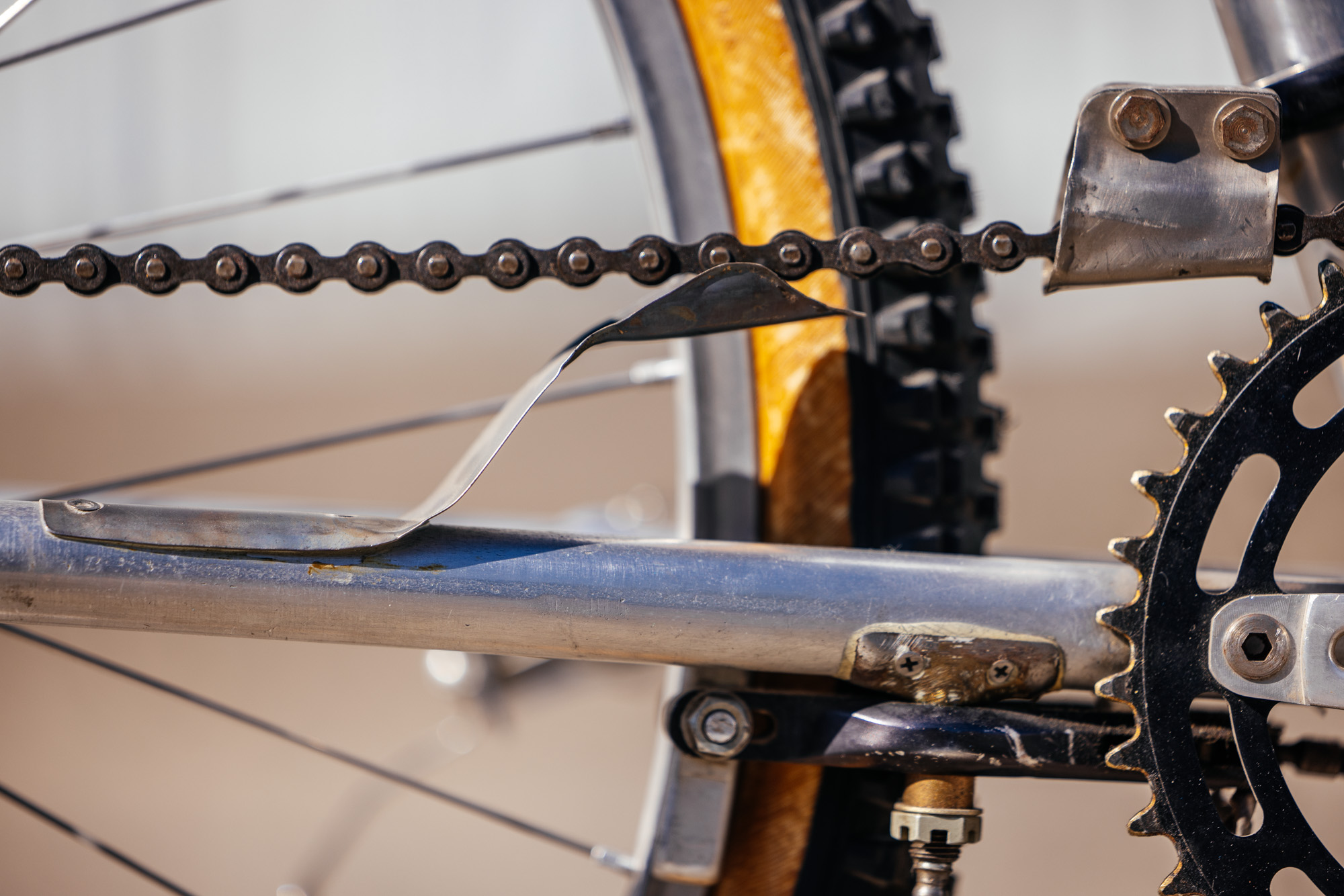
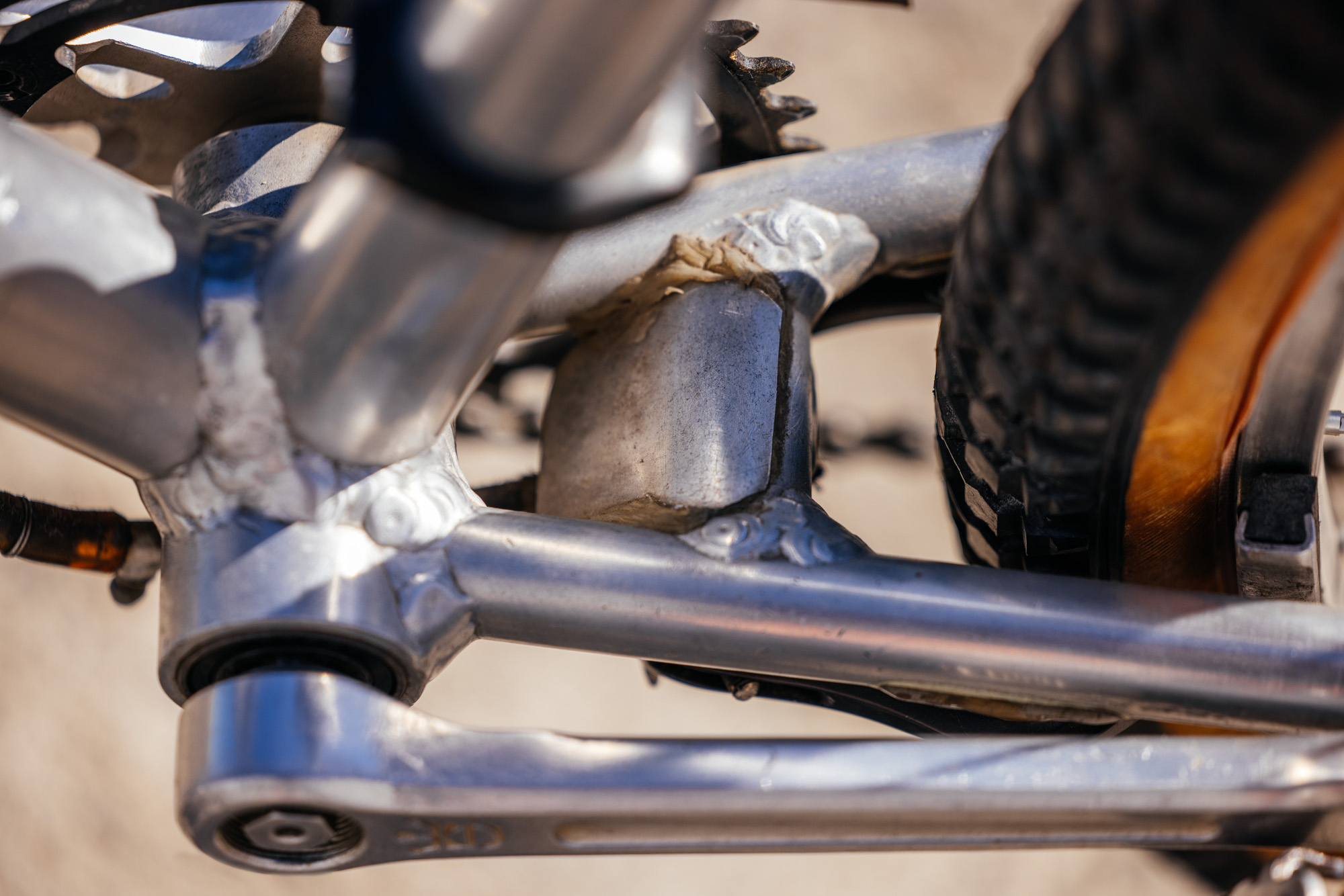
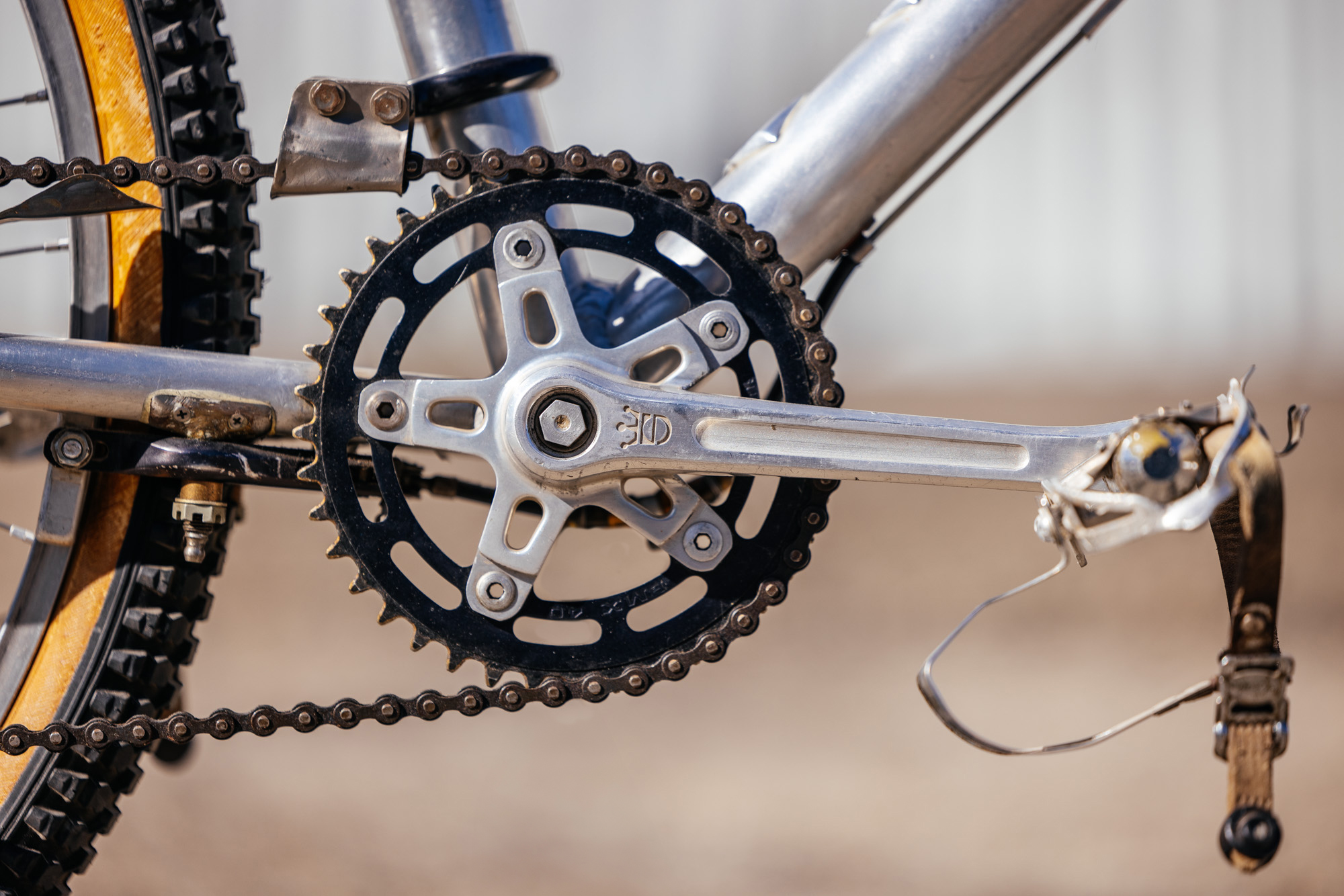
A small aluminum shield epoxied to the top of the chainstays helps keep mud coming off the rear tire from loading up on the intricate brake linkage. The bike runs a single chainring, but a guide fashioned from titanium that clamps to the seattube keeps the chain from popping off. In the days well before modern narrow-wide chainrings, Charlie called this device a “Rerailleur.” To reduce chain slap and protect the chainstay, Charlie fashioned a titanium sheet into another guide he riveted to the chainstay, although this is another more recent addition.
Wider is Better
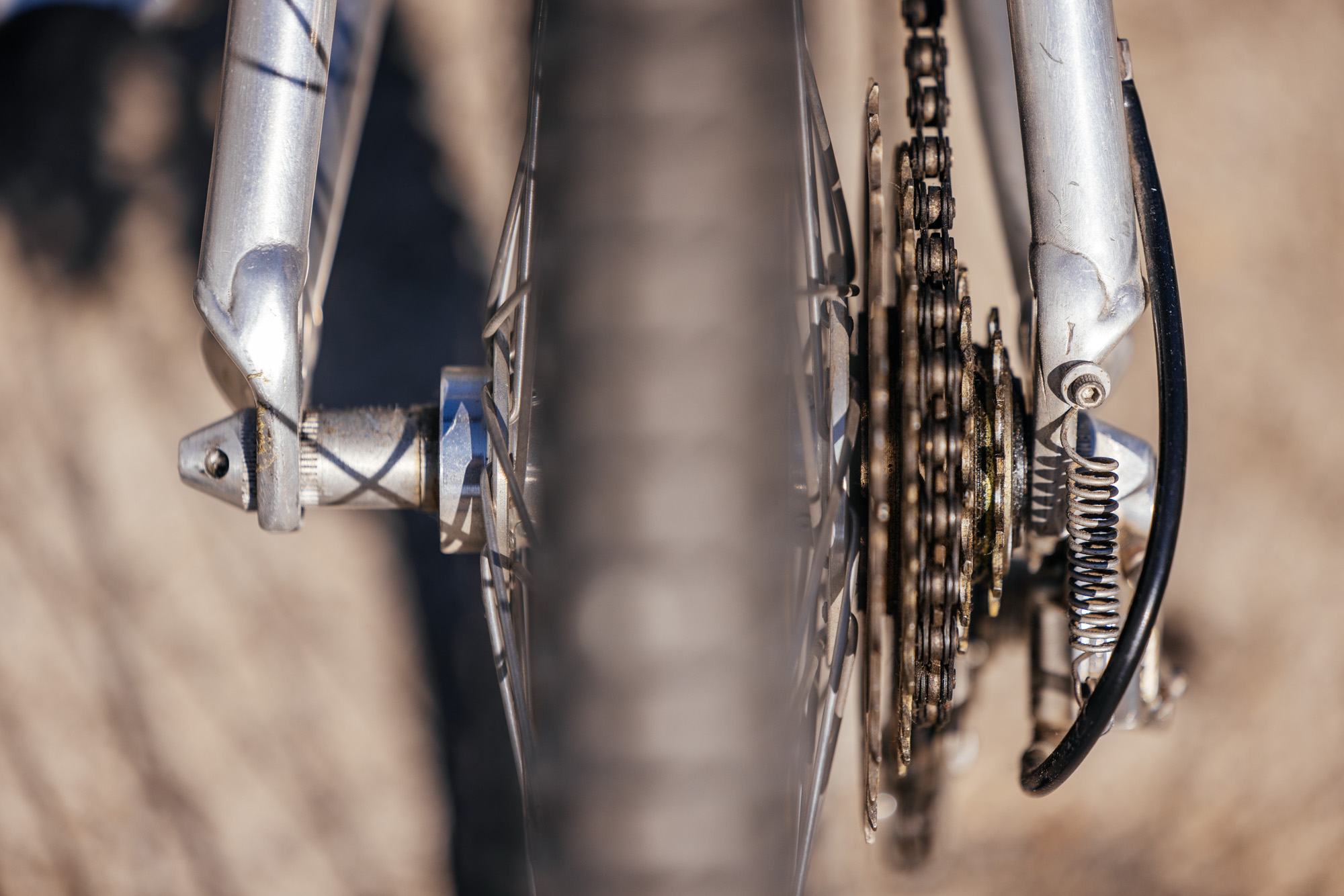
Just like the front end, Charlie was also thinking about what makes a durable rear wheel. Although the bike industry never adopted his 115 mm front dropout spacing, he did prevail with establishing 135 mm rear spacing until modern through-axles pushed it even wider. Pairing this spacing with a 5-speed freewheel, at a time when road bikes were already using 6 speeds, allowed Charlie to achieve symmetric left-right spoke angles with even tension. The simplicity of a single chainring drivetrain puts a lot of demands on the gearing range of a freewheel with only 5 cogs. Although Suntour made freewheels at the time with 38 teeth for touring bikes, the smallest cog that would fit had 14 teeth, limited by the large body of the freewheel. Getting down to 12 teeth required a Suntour Winner body intended for sprinting on a road bike. Unfortunately, the splines and threads on the cogs weren’t cross compatible, so Charlie ground new splines in the Winner body, brazed cogs together, and fashioned custom spacers. This heroic effort was simply what was needed to make a capable off-road drivetrain at the time.
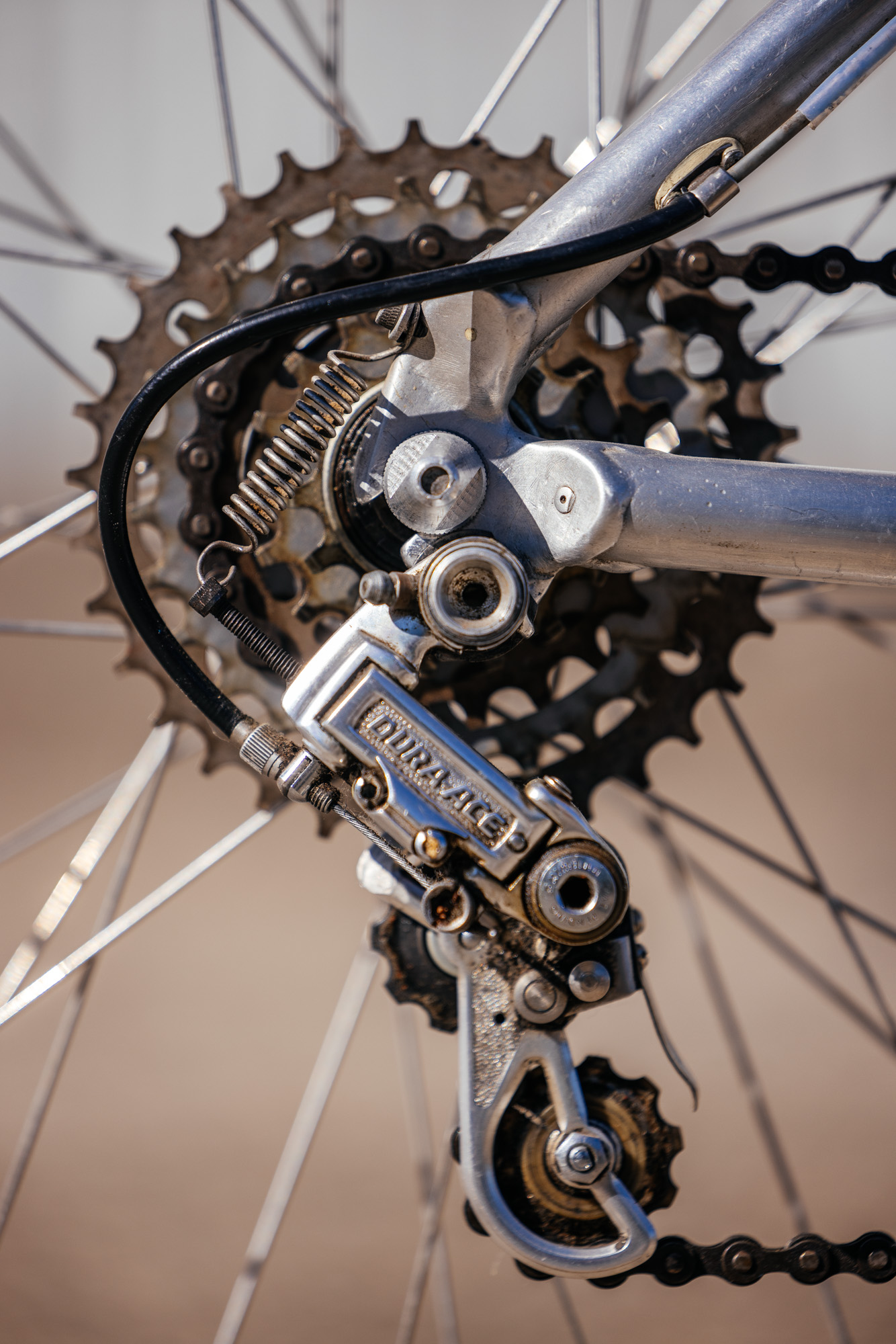

Charlie’s functional improvements extended to the Dura Ace rear derailleur, which needed adaptation to shift over the wide freewheel, yet he wanted to retain the short road cage for fast shifts and better chain management. The upper pulley needed to be able to get behind the 38-tooth cog, which meant pulling the derailleur body back. Charlie accomplished this by adding an external spring and a grease fitting to the main pivot to ease rearward motion and do so consistently. No slanted parallelogram, no B-knuckle, no long cage, no clutch, no fancy shift gates. Just careful massaging, modification, and adjustment. Steel hardware was replaced with aluminum, and parts were shaved down to save weight. Charlie fashioned a titanium shield over the lower pulley to protect against mud and debris.
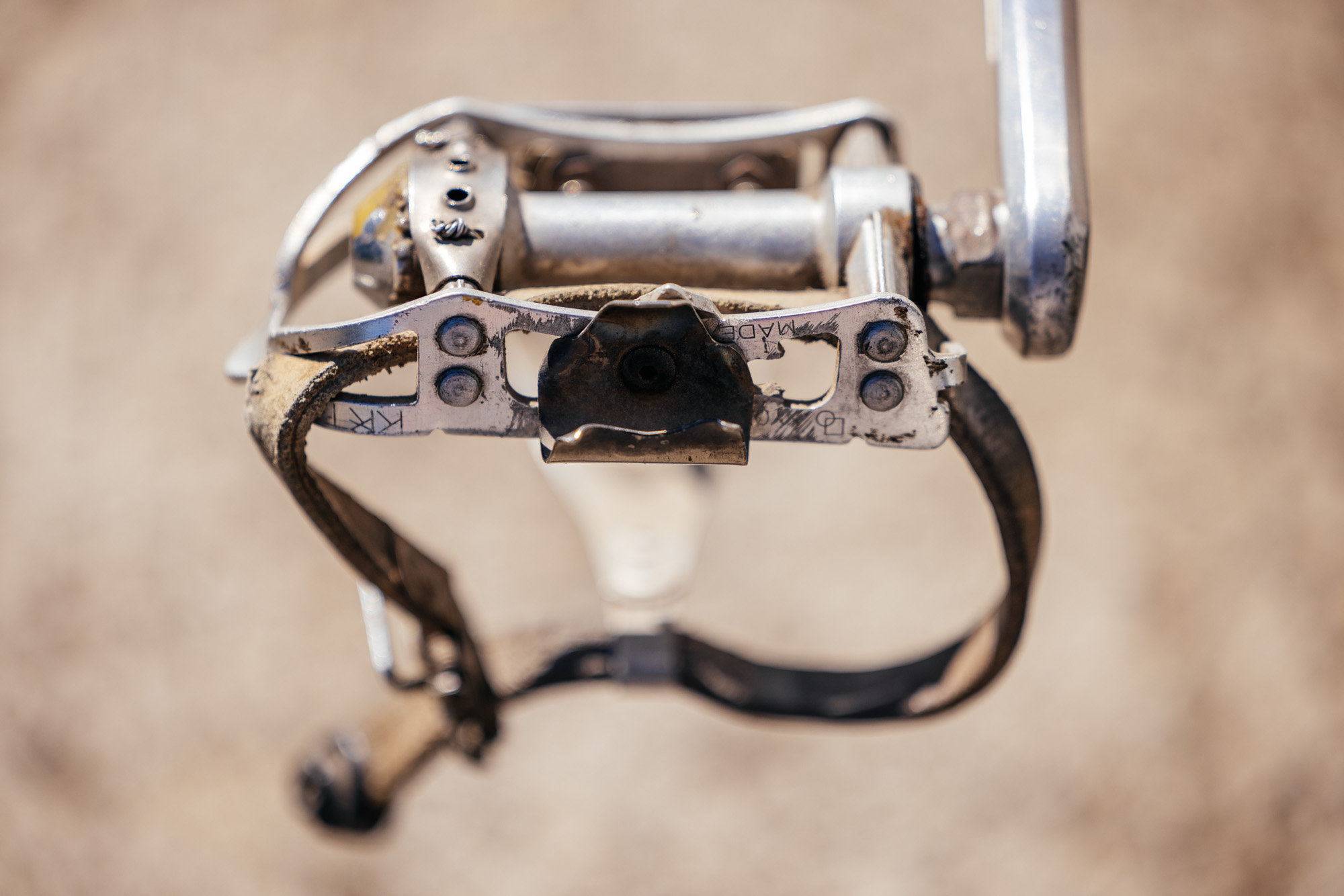
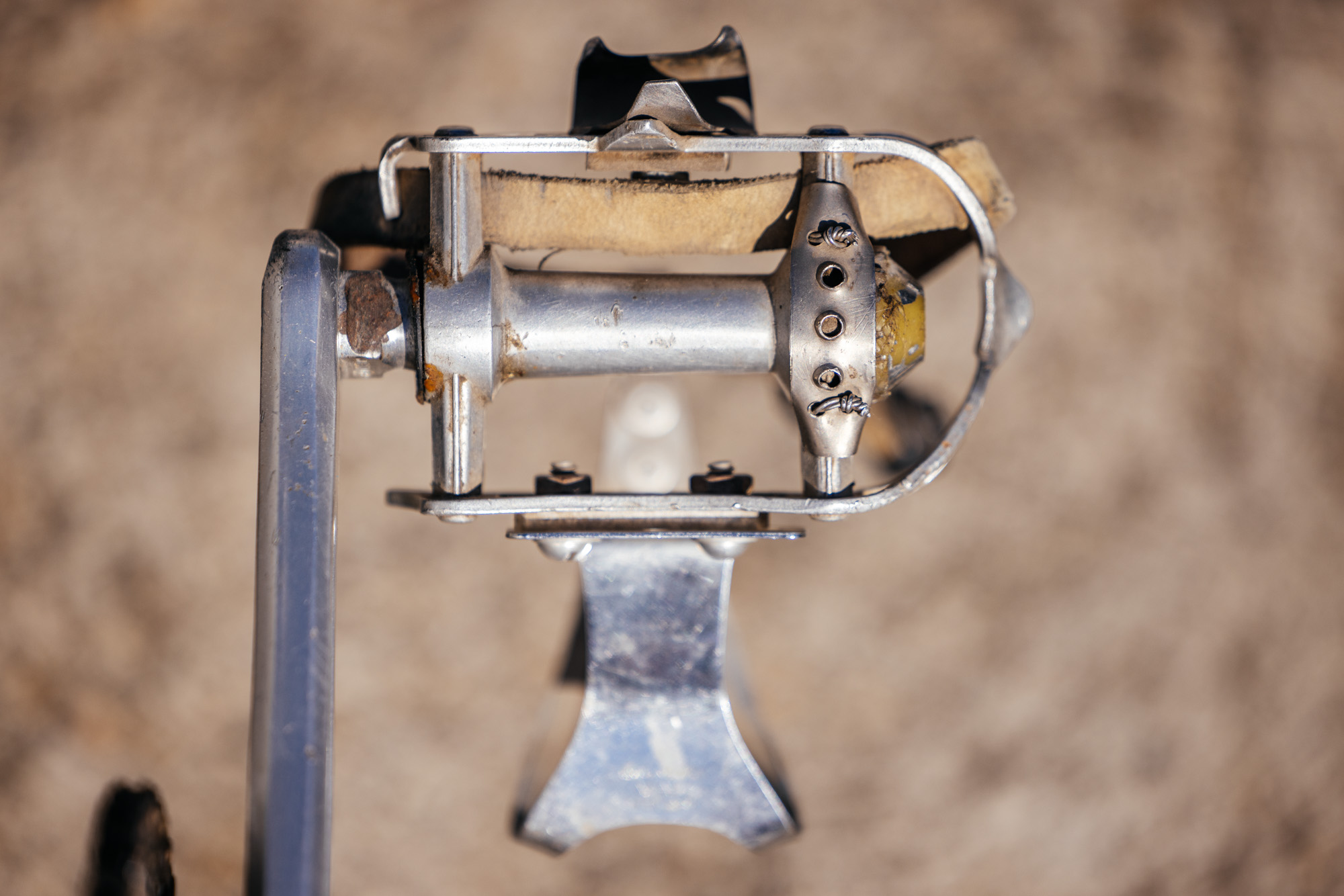
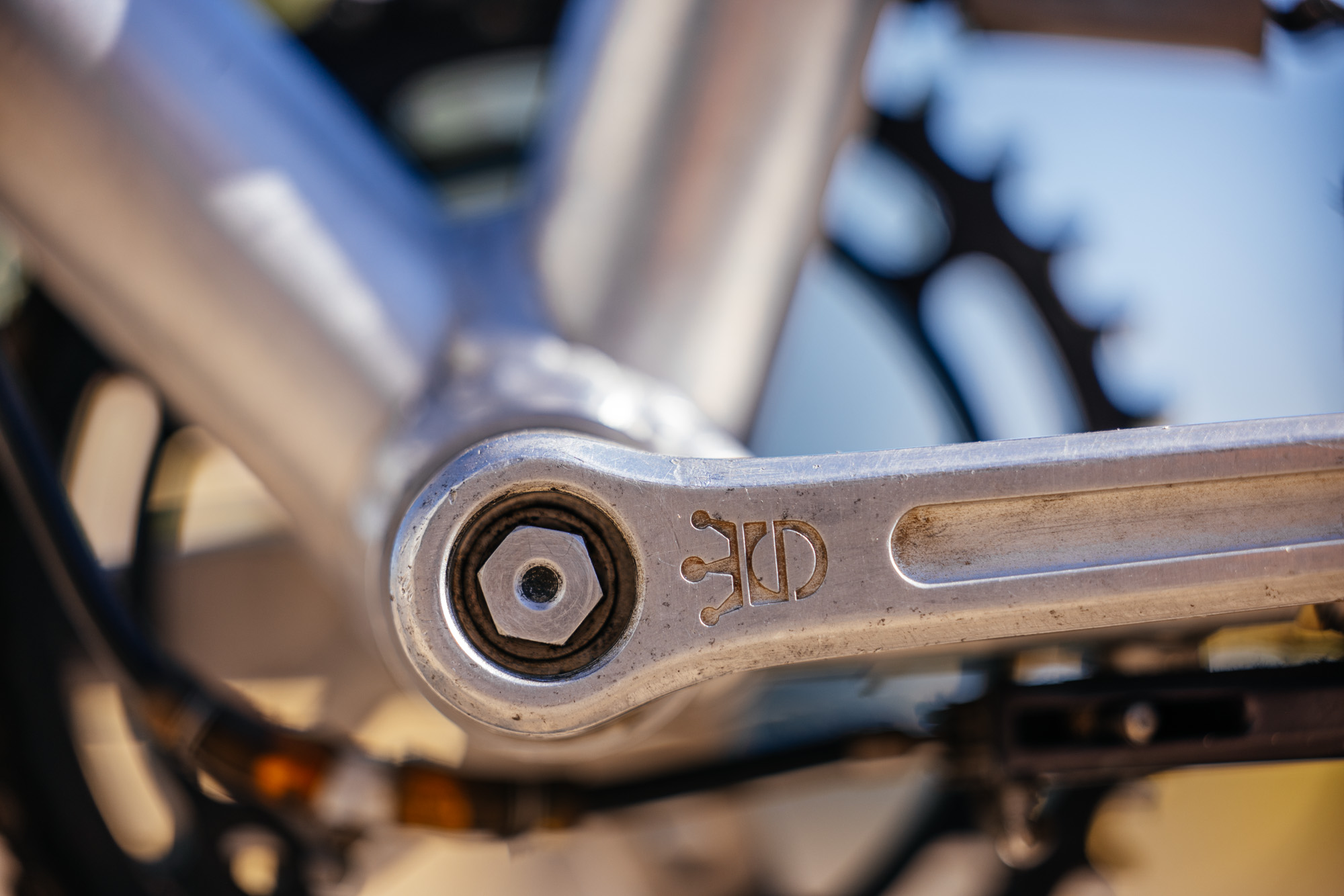
With a single 42-tooth chainring and no need for anything less than 34 teeth, Charlie had more crank options than the flexy Specialities T. A. Cyclotouriste everyone else was using as a double or triple. The Sugino Mighty Tour on CCPROTO had a 110 mm bolt circle diameter and durable forged arms. Charlie was a strong believer in narrow Q-factors and short spindles, so the back side of the crankarms near the pedal holes has been shaved down to increase clearance with the chainstays. He also shaved down the aluminum chainring bolts and made aluminum “keeper” crankarm bolts to save weight. Charlie was likely the first to use toe clips on a mountain bike, firmly believing that a secure connection was the key to efficient power transfer. The KKT pedal cages were modified to easy shoe entry and exit, titanium traction plates were added to the bottom side for secure unclipped riding, and spring steel “Toe-Flips” were installed to upright the pedals. Charlie also added a second set of wrench flats on the pedal spindles.
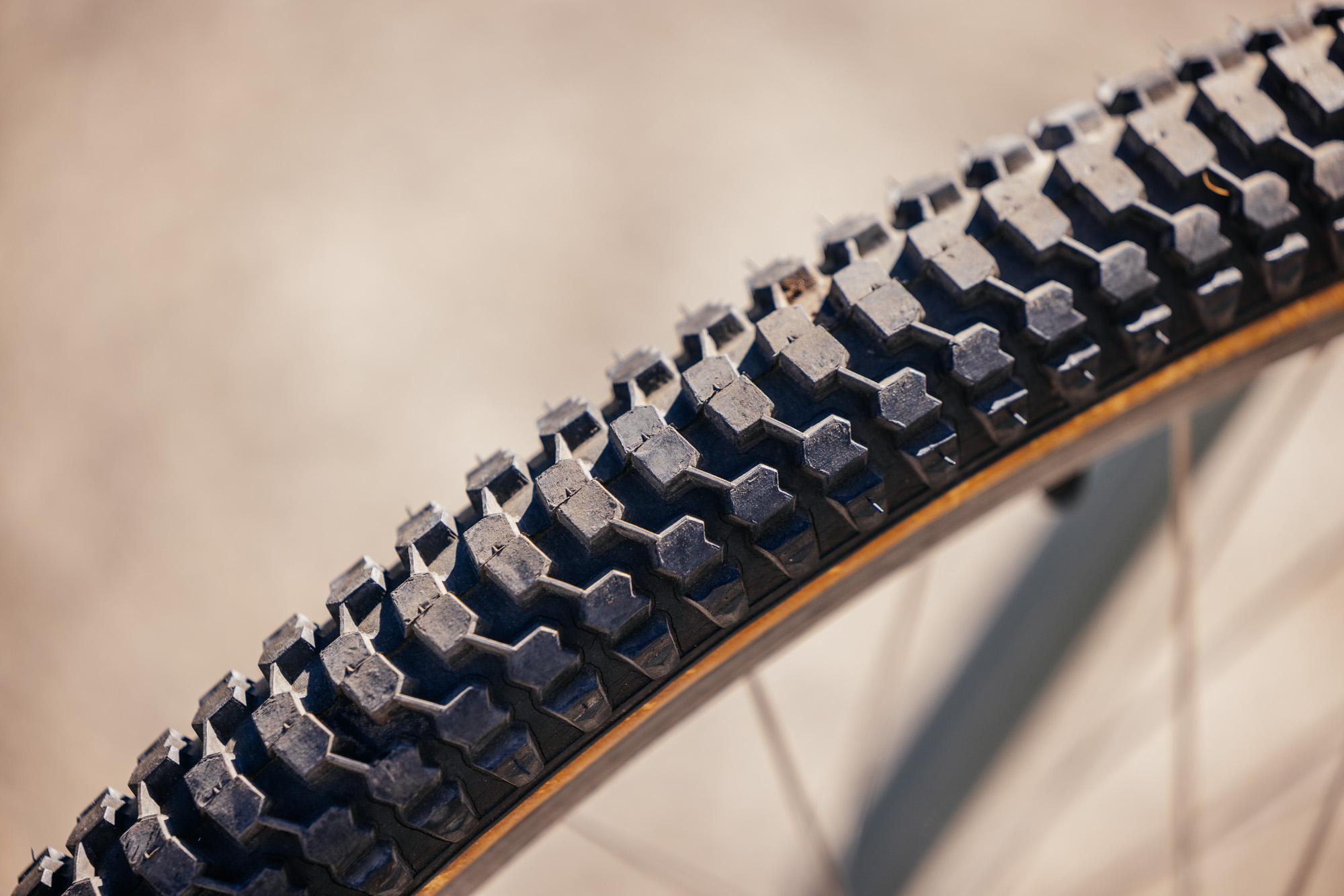
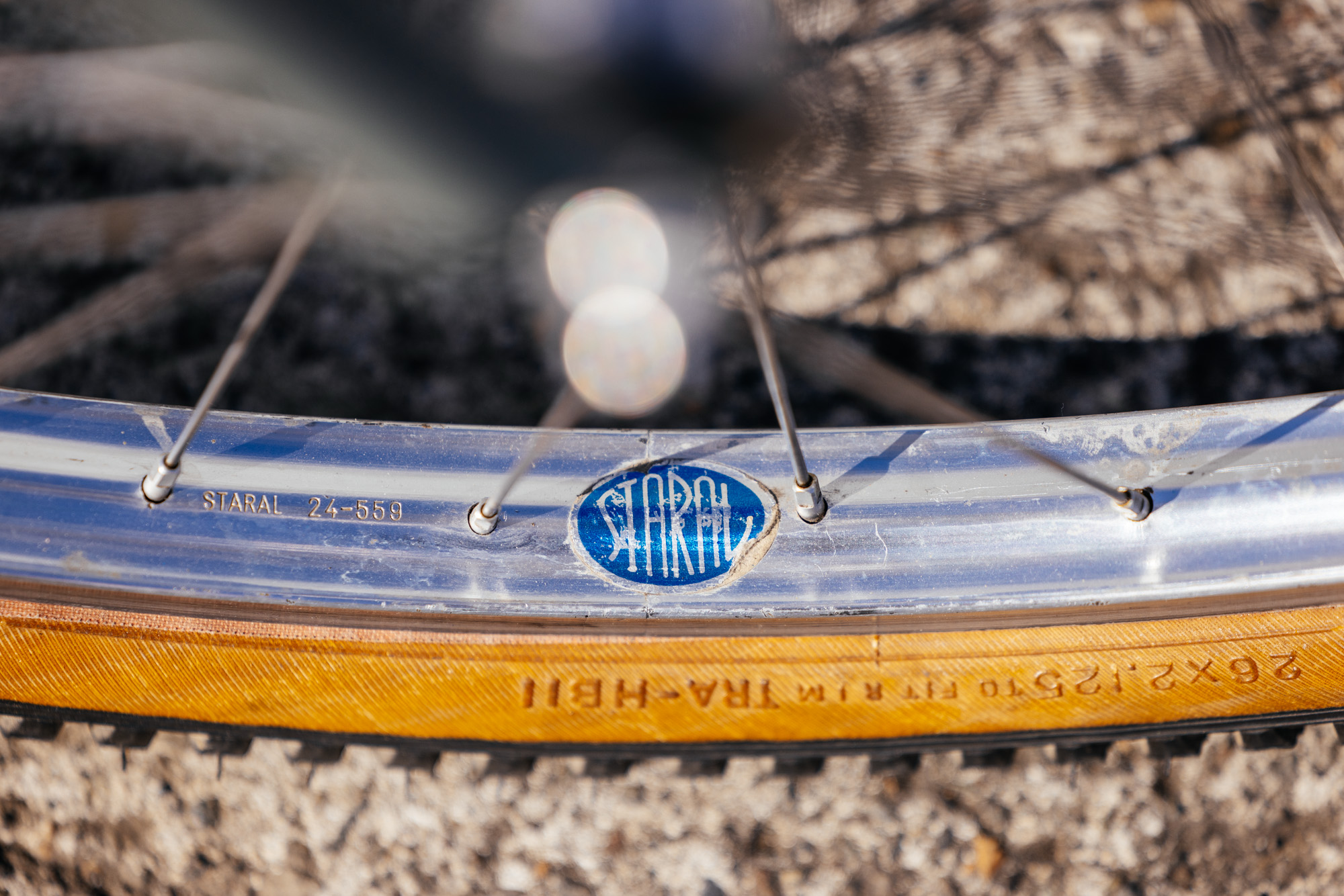
Charlie really wasn’t inclined to build an off-road bike until lightweight alloy rims from Ukai and Araya became available, along with Cycle Pro Snakebelly tires. Using these new products dropped 5 pounds of rotating weight off what was available before. CCPROTO weighs just 23.5 pounds. Interestingly, Charlie built CCPROTO and his other early bikes with aluminum rims from Staral, which was a European brand of decent quality that appeared on Raleigh bikes of the era. The 26-inch Staral rims were a feathery 520 grams each, which was almost 20 % lighter than the Araya 7X. However, there was a problem with diameter control in the manufacturing process, and Don Cook recalls having to sort through a stack of Staral rims to find the larger ones that would better keep tires from blowing off.
Ah, Charlie, the weight weenie strikes again!
A Lifetime of Innovation
Over the next 32 years, Charlie would create some 185 frames, most of which were mountain bikes. As they were produced, an increasing number of those bikes looked like CCPROTO, with sloping toptubes, big seatposts, straight blade forks, and drop handlebars. People clearly began to adopt Charlie’s vision of a mountain bike. It was a lasting vision, perhaps because he had put in so much deep thought from the beginning. The innovation didn’t stop; however, Charlie began to put more effort into commercializing his rollercam brake design and licensing Grease Guard, both with Suntour. WTB also took off as a company with the success of Charlie’s Ground Control tire design and the production of its Grease Guard hubs.
As was his nature, Charlie continued to tinker with new ideas and better ways of doing things. One innovation he didn’t pursue was his single chainring drivetrain, as companies like Suntour and Shimano developed better gearing systems specifically for mountain bikes. In fact, he never tackled something big like a complete redesign of the rear derailleur, which he felt was already pretty optimal with minor modifications to better suit his needs. Although he didn’t personally experience SRAM’s single-chainring XX1 group released in 2012, it’s safe to say that he would have been appalled at the poor chain line it relied on to work. In the 1990s, he would dabble with unified rear triangle suspension designs, but still felt like the body was the best form of suspension. Toward the end of his riding and building, he was able to realize his long-held belief that bigger wheels roll better, culminating in his personal 29er in 2012. At the very end, he became fascinated with the low-trail geometry of French randonneur bikes like those from Alex Singer.
CCPROTO
With all that has been said, what conclusions can we draw about what it takes to innovate by thinking outside the box? In the case of Charlie’s creation of CCPROTO, it seems reasonable that other people, like Tom Ritchey, would also have been alarmed by the weight of the early klunker bicycles and focused on dieting through established methods like material substitution and “drillium.” You can probably train yourself to be a good weight weenie, but Charlie just took it a lot farther than anyone else. Skilled engineers have long been attracted to the challenge of designing efficient bicycles, in all their many forms. The Wright brothers started with bicycles before turning their attention to airplanes.
You can earn a degree in mechanical or aeronautical engineering and apply your skills to bicycles by methodically refining each part. There are plenty of examples of this over the years, both good and bad. Here, Charlie applied what he had learned and continued to learn as the years went by. Charlie’s expressed his independent thinking through so many aspects of his life. For the rest of us, living that way is a daunting proposition: going against the grain, not caring what other people will say, and potentially being marginalized or ignored.
It can’t be “independent thinking” just for the purpose of being different, like dyeing your hair blue.
Unfortunately, it doesn’t appear that independent thinking is a skill that can be taught. We might be trained to question everything, but that doesn’t guarantee innovative solutions, even if combined with deep thought. Where others might have been stumped, Charlie had the freedom to see many new possibilities and ways to do it better.
For the rest of us, we are left to sit back and marvel at what Charlie was able to create and feel fortunate that he shared it with us.
You can see the CCPROTO in person at the Marin Museum of Bicycling.